



Key Takeaways
- Why does robotaxi vision need more than task-driven ADAS sensing?
- Impact of long-duty operation and changing lighting on perception reliability
- Challenges faced across vehicles, cities, and operating conditions
- How visual data continuity affects incident review, validation, and regulatory audits
ADAS brought cameras into vehicles to handle limited driving tasks under human supervision. Vision pipelines fed data for functions such as lane guidance, collision alerts, and parking assistance. These systems operated for short durations, handled narrow scenarios, and relied on a driver to interpret situations and take responsibility.
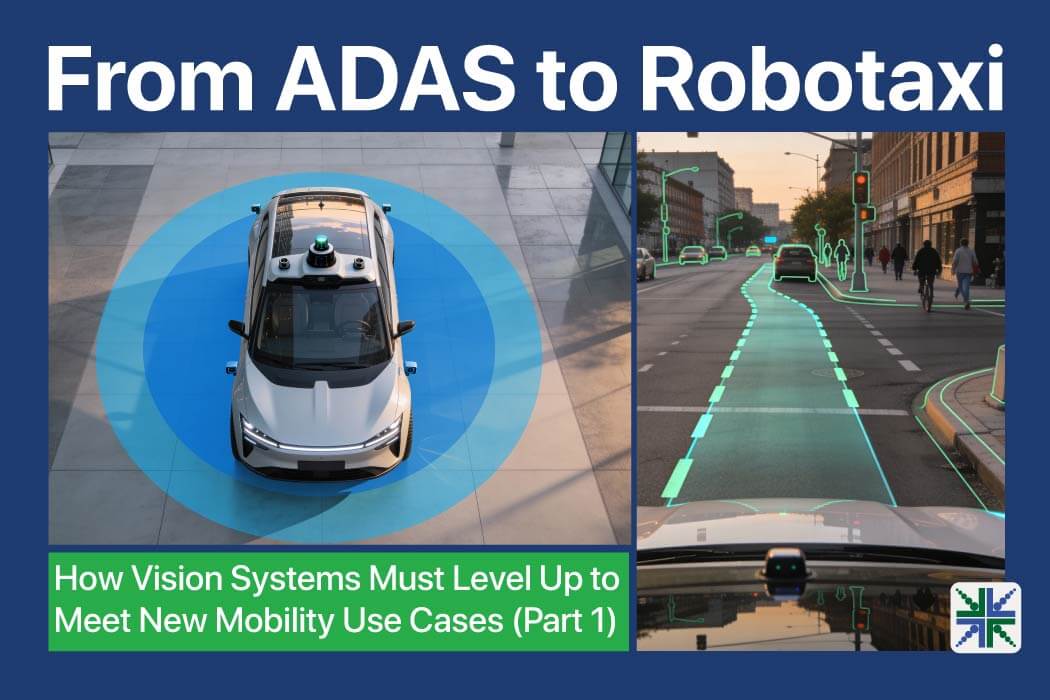
Robotaxi deployments change the operating contract entirely. Vehicles run continuously in busy cities, interpret dense interactions among road users, and act autonomously at all times. Hence, vision systems are expected to move from task-based sensing to full-scene perception, where every decision depends on what cameras capture, process, and pass forward.
In this blog, you’ll see how mobility has progressed, which vision challenges have emerged, what camera features are most needed, and why integrated AI vision boxes become critical.
How Robotaxi Vision Differs From ADAS Vision
ADAS started as a camera-plus-algorithms stack focused on driver-assist functions. That stack typically pairs an embedded vision system with ADAS algorithms that detect and recognize vehicles, pedestrians, traffic signs, obstacles, and lane lines, then feeds functions like lane departure warning, collision warning, blind-spot detection, parking assistance, and driver monitoring.
With autonomy levels rising, the camera layout expands from up to two forward-facing cameras to forward, rear, and surround-view coverage for 360° perception, including low-speed scenarios like parking and reverse assist.
Research has already pointed to the growing L1 and L2 penetration across vehicle segments, alongside rising driver monitoring adoption driven by regulatory mandates. Robotaxi mobility evolves the vision foundation into a fleet-grade, always-on model, with L4 programs extending it from driver-assist use into fully autonomous operations. In fact, today, research projects robotaxi proliferation in North America and the EU. Its market size is expected to rise from $4.43 billion in 2025 to $188.91 billion by 2034.
This changes what “good enough” means for embedded vision. It moves from feature enablement in consumer vehicles to dependable perception inside a commercial ride service, where uptime, repeatable performance, and operational scale take center stage.
Major Vision Challenges That Robotaxi Must Overcome
Pressure on perception during continuous movement/changing lighting
Robotaxi vehicles remain active for long stretches of time in live city traffic. Cameras face harsh sunlight, deep shadows between buildings, headlight glare at night, rain streaks on lenses, and frequent lighting transitions at intersections. Unlike test or feature-triggered driving, perception pipelines stay active across the full operating window, which raises stress on sensors, optics, and image pipelines over extended duty cycles.
Uneven monitoring across long-duty fleet operation
Robotaxi programs operate fleets rather than individual vehicles. Vision performance must remain consistent across hundreds or thousands of vehicles deployed in different cities and climates. Small variations in camera alignment, thermal capability, or image timing can lead to uneven perception outcomes. Fleet operations depend on vision systems that behave the same way vehicle to vehicle, day after day.
Gaps in visual data during review, validation, and audits
Robotaxi deployments face constant scrutiny from regulators, city authorities, and the public. Camera data feeds incident review, system validation, and safety audits. Vision pipelines must preserve timestamp accuracy, synchronization, and data integrity over long operating periods. Any gaps in visual records weaken the ability to explain decisions, reconstruct events, or demonstrate operational readiness during reviews.
As mobility evolves from ADAS to fully autonomous robotaxi deployments, vision systems face a new set of demands and challenges. In Part 2 of this series, we will dive into the five essential camera features required for robotaxi-grade perception and explain why unified AI vision boxes like Darsi Pro play a critical role in meeting these requirements at scale.
e-con Systems Offers Vision Solutions for New Mobility Use Cases
e-con Systems® designs, develops, and manufactures OEM camera and vision solutions with over 20 years of embedded vision expertise. We provide several automotive-focused cameras for ADAS, surround-view systems, agri-tech, robotics, smart surveillance systems, and more. Darsi Pro is our unified AI vision box that can go a long way to give robotaxis the future-ready imaging power they truly need.
Explore our mobility vision expertise.
Use our Camera Selector Page to check out our full portfolio.
If you need help finding and deploying the right vision solution into your mobility application, please write to camerasolutions@e-consystems.com.
FAQs
- How do vision requirements change when moving from ADAS to robotaxi deployments?
ADAS vision focuses on limited driving tasks under human supervision, where cameras operate for short durations and within narrow scenarios. Robotaxi vision works under continuous operation in busy city environments, where cameras handle full-scene perception, dense interactions, and long-duty cycles.
- Why do robotaxi programs place higher pressure on perception pipelines?
Robotaxi vehicles remain active for long stretches in live traffic with glare, shadows, night driving, and frequent lighting transitions. Vision pipelines stay active across the full operating window rather than triggering for individual features. Extended exposure raises stress on sensors, optics, and image pipelines.
- Why does fleet-scale operation create vision consistency challenges?
Robotaxi programs operate hundreds or thousands of vehicles across different locations and climates. Small differences in camera alignment, thermal behavior, or image timing can create uneven perception. Fleet operation depends on vision systems that behave consistently vehicle to vehicle over time.
- Why does continuous robotaxi operation change how vision data must be captured and retained?
Robotaxi vehicles operate for long stretches across busy urban environments, where camera feeds support incident review, system validation, and safety audits. Visual records need consistent timestamps, synchronization, and integrity across extended duty cycles. This continuity supports event reconstruction and system review during regulatory or operational scrutiny.
- Why do lighting transitions and long-duty cycles place sustained pressure on robotaxi vision systems?
Robotaxi cameras face harsh sunlight, deep shadows, headlight glare, weather exposure, and frequent lighting shifts throughout the day and night. Vision pipelines remain active across the full operating window rather than short feature-driven intervals. Extended operation increases demands on sensors, optics, and image pipelines to maintain dependable perception over time.

Suresh Madhu is the product marketing manager with 16+ years of experience in embedded product design, technical architecture, SOM product design, camera solutions, and product development. He has played an integral part in helping many customers build their products by integrating the right vision technology into them.