



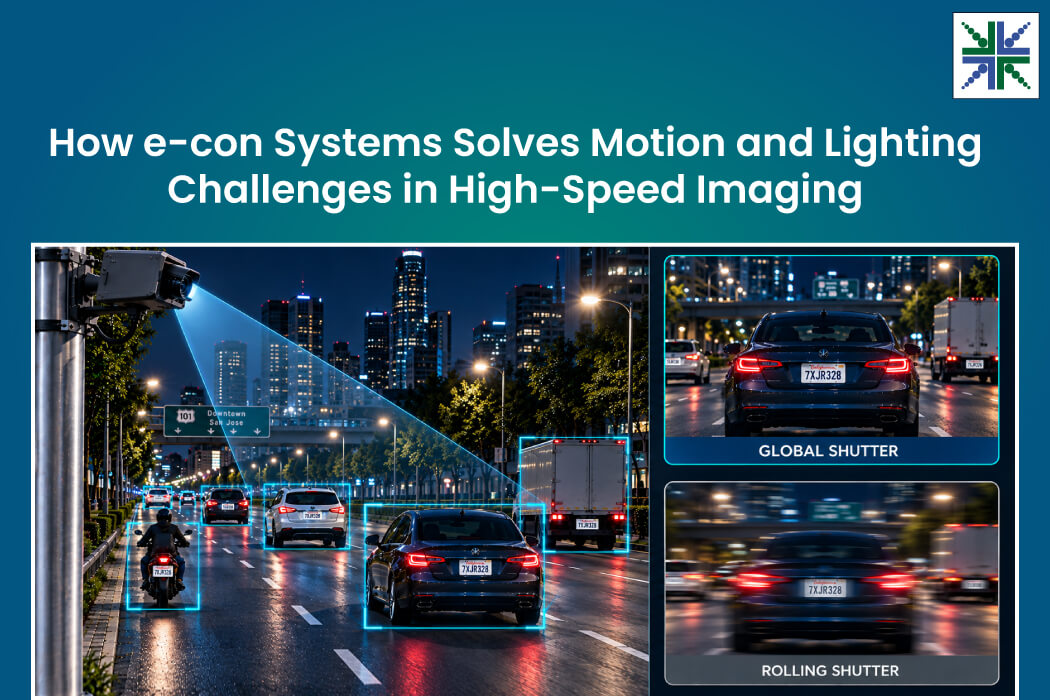
Capturing fast-moving objects requires both precise image capture and controlled illumination. Fast-moving objects can introduce motion-related distortion, while the short exposure times used to freeze motion can reduce the light reaching the sensor.
A global shutter camera addresses motion-related distortion by capturing the entire frame simultaneously, making it suitable for imaging fast-moving objects. However, the short exposure time can still limit the light the sensor captures. The camera’s strobe function provides a synchronized output to trigger an external light source, such as an LED or infrared illuminator, in coordination with the camera’s exposure.
This synchronized illumination provides sufficient light during the image-capture interval, helping maintain consistent image brightness and capture sharper images in high-speed applications.
Key Takeaways
This blog offers insights to help you understand:
- How strobe functions differ between global-shutter and rolling-shutter cameras
- How camera exposure and external lighting are synchronized for precise capture
- The key benefits strobe synchronization brings to image quality and system design
- Where different global-shutter sensor-based cameras get deployed for high-speed imaging
Understanding Strobe Operations in Global and Rolling Shutter Cameras
A camera with a strobe function provides a dedicated strobe output that controls external illumination, such as an LED, laser, or infrared light, through a suitable lighting controller or driver. When triggered, the strobe signal triggers an intense light pulse for a defined duration.
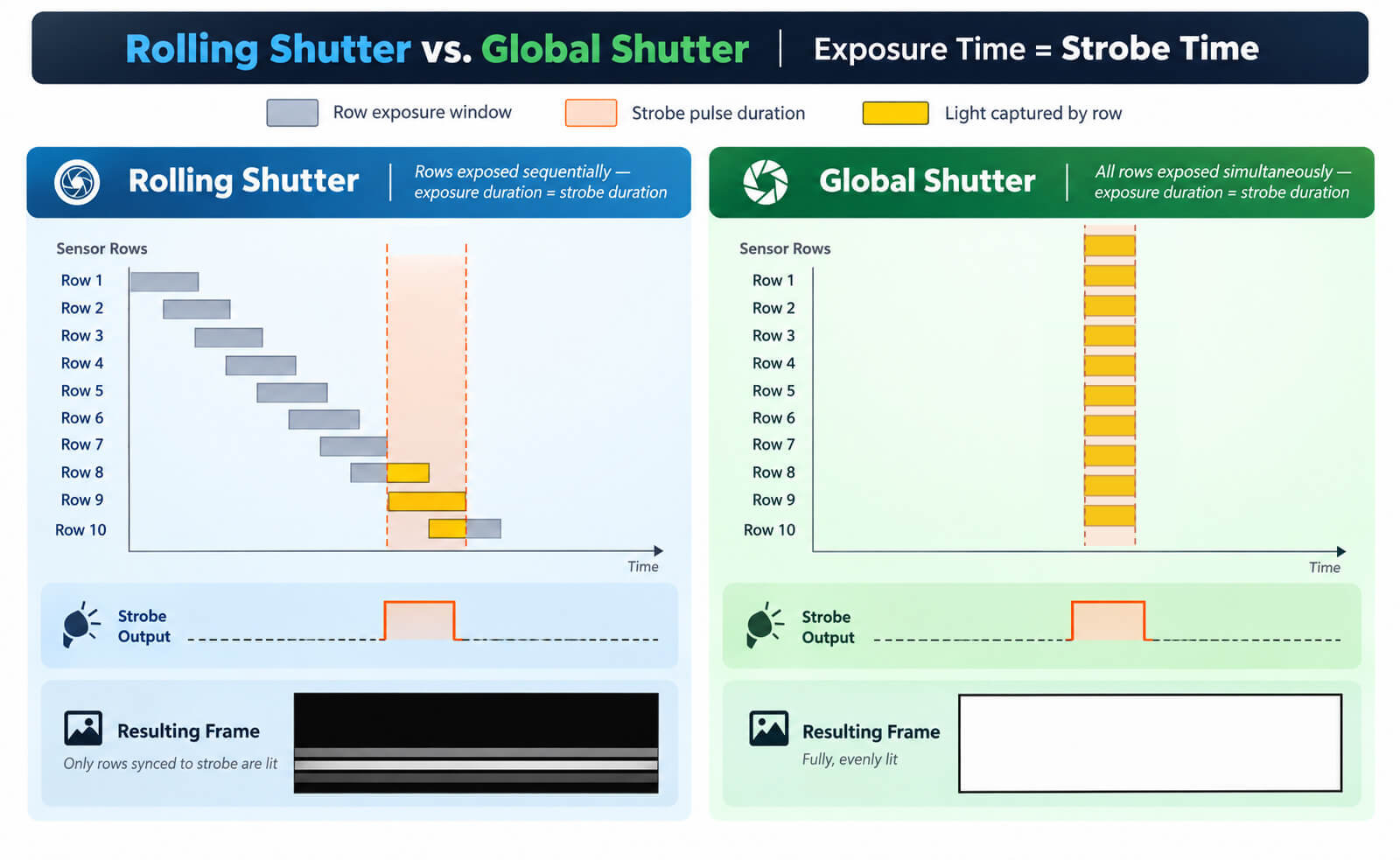
In a global shutter camera, all pixels start and finish their exposure at the same time by synchronizing the strobe pulse with this exposure period and illuminating the scene with external light at the right moment. This helps the camera capture the entire frame under consistent lighting.
In a rolling shutter camera, rows are exposed sequentially at different times. Therefore, a short strobe pulse may illuminate only part of the sensor as different rows are exposed, potentially resulting in uneven brightness or illumination bands. Proper synchronization of the strobe timing and duration with the sensor’s row exposure is therefore more critical. The figure below shows conceptual diagrams of rolling-shutter and global-shutter exposure.
Why Is Strobe Important for High-Speed Imaging?
In high-speed imaging applications, short exposure times are needed to capture fast-moving objects. However, short exposure times reduce the light reaching the sensor, which can result in darker or noisier images. Strobe lighting addresses this by providing a short, intense light precisely when the camera captures the image.
By matching the camera’s exposure to the strobe pulse, the global shutter camera can capture images by illuminating light only when necessary. This approach delivers excellent image quality.
Strobe lighting is very useful in applications such as industrial inspection, robotics and industrial automation where cameras need to capture fast-moving objects with reliable image quality.
How Strobe Synchronization Works in Practice
In a typical camera-driven setup, the camera sends a strobe signal to the lighting controller when the sensor starts exposure. This signal triggers the light, so it turns on during the exposure window.
This keeps the lighting in sync with the camera exposure and eliminates the need to separately account for the camera’s trigger-to-exposure delay.
Key Benefits of Strobe Synchronization with Global Shutter
Motion-Blur-Free Imaging
In embedded vision applications such as conveyor-belt inspection and license plate recognition, moving objects can be blurred when exposure times are too long.
A global shutter captures all pixels at the same instant, while a short, intense strobe pulse provides illumination during this exposure period. This synchronized operation minimizes the amount of object movement recorded during image capture, helping produce sharper images of fast-moving objects.
Improved Signal-to-Noise Ratio (SNR)
Increasing sensor gain to compensate for low-light conditions can add noise to the image. By providing higher-intensity illumination during the exposure period, strobe lighting lets the camera operate at lower gain levels while maintaining image brightness, improving image quality and signal-to-noise performance.
Consistent Illumination
Scene illumination varies greatly depending on operating conditions. A synchronized strobe light provides a controllable illumination system, thus ensuring constant image brightness during the imaging process.
Reduced Power Consumption
Unlike continuous illumination, a strobe operates only for a short time during image capture. This can reduce the illumination system’s average power consumption while still providing the required light intensity, depending on how long the light is on, how often it pulses, and the type of light source.
How e-con Systems’ Global Shutter Cameras Solved Challenges Across Different Sectors
Camera solutions based on different global-shutter sensors can address application-specific requirements across industrial, transportation, and agricultural sectors. Here are some e-con Systems cameras designed to address application-specific motion and illumination challenges across various vision applications.
Barcode Scanning
In automated warehouses and logistics systems, products can move rapidly along conveyor belts, cameras need to capture fast-moving packages and their barcodes. A short strobe pulse synchronized with the global shutter camera provides controlled lighting while minimizing motion blur.
e-con Systems’ Sony IMX900-based See3CAM_37CUGM’s self-trigger functionality can initiate image capture when activity within the defined region of interest reaches a specified threshold, helping automate image acquisition as packages enter the inspection area. Its global shutter captures the moving packages without the geometric distortion associated with rolling-shutter exposure. At the same time, the camera’s strobe control can synchronize a short burst of illumination with image capture, providing consistent lighting and helping reduce motion blur during barcode inspection.
ANPR and Traffic Monitoring
In intelligent transportation systems, vehicles may travel at high speeds and need to be captured across multiple lanes under varying lighting conditions. Capturing sharp license plate images requires minimizing motion effects while providing consistent illumination.
e-con Systems’ AR0234-based cameras support high-speed image acquisition to capture fast-moving vehicles with reduced motion-related image degradation. Their strobe control enables synchronized illumination during image capture, helping maintain consistent lighting on license plates across varying ambient conditions. Together, these capabilities support clear and reliable license plate images for ANPR and traffic monitoring applications.
Driver and Cabin Monitoring System
Inside the bus or car, driver and cabin monitoring systems often operate with infrared illumination during low-light conditions. Ambient light can affect image consistency if illumination is not controlled.
e-con Systems’ OV2311- and OX05B1S-based camera solutions combine global shutter imaging with NIR sensitivity. The global shutter helps minimize motion-related distortion during image capture, while NIR sensitivity enables the cameras to capture facial and eye features using infrared illumination in bright and low-light conditions. These capabilities support applications to detect signs of microsleep and reduced driver alertness.
Medical Imaging and Agricultural Robotics
Applications such as medical imaging and agricultural robotics can require precise image capture of moving subjects or objects under controlled lighting. The exposure method therefore becomes an important consideration when preserving spatial information in the captured image.
e-con Systems’ Sony IMX568-based camera uses a global shutter to capture the entire frame simultaneously, helping preserve the shape and spatial information of moving objects. Its 5MP resolution and high frame rate provide detailed image data for high-speed imaging and analysis, while the sensor’s high sensitivity supports image capture in low-light conditions and the NIR spectrum.
Conclusion
Global shutter cameras, combined with the strobe feature, enable precise synchronization of exposure with an external light source. This provides more consistent, controllable illumination across changing lighting conditions. This is especially useful when you want to capture images of fast-moving objects and keep lighting consistent across captures.
e-con Systems’ Reliable Global Shutter Cameras
Since 2003, e-con Systems has been designing, developing and manufacturing embedded vision solutions—from custom OEM cameras to complete ODM platforms. Over the years, we’ve worked across a wide range of vision applications and delivered application-specific camera solutions, including global shutter and strobe solutions.
Explore our Global Shutter Cameras to learn more about our solutions, available sensors, interfaces, and features.
Visit our Camera Selector Page to view and compare camera options based on your requirements.
If you need guidance on selecting a camera for your specific application, contact our vision experts at camerasolutions@e-consystems.com for assistance.
Frequently Asked Questions
1. What is the strobe function in a camera?
The strobe function provides a synchronization signal from the camera to an external light source, such as an LED, laser, or infrared illuminator. The external light source is activated in synchronization with the camera’s exposure period to provide illumination during image capture.
2. How does strobe synchronization work with a global shutter camera?
In a global shutter camera, all pixels begin exposure simultaneously. The camera’s strobe output is synchronized with the exposure period, allowing the external light source to illuminate the scene during image capture. This ensures consistent illumination across the entire frame.
3. Does a strobe function help reduce motion blur?
Yes. A short-duration, high-intensity strobe pulse can effectively reduce the time during which a moving object is illuminated. When the strobe is synchronized with the exposure of a global shutter camera, this can help capture sharper images of fast-moving objects and reduce motion blur.
How does strobe control improve image quality in low-light conditions?
The camera’s strobe output synchronizes an external light source with the camera’s exposure, providing controlled and high-intensity illumination during image capture. This can allow the camera to achieve the required image brightness with lower sensor gain, which can help reduce image noise and improve the signal-to-noise ratio (SNR).
You can also refer to our Embedded Camera FAQs for answers to common camera integration and troubleshooting questions.

Prabu is the Chief Technology Officer and Head of Camera Products at e-con Systems, and comes with a rich experience of more than 15 years in the embedded vision space. He brings to the table a deep knowledge in USB cameras, embedded vision cameras, vision algorithms and FPGAs. He has built 50+ camera solutions spanning various domains such as medical, industrial, agriculture, retail, biometrics, and more. He also comes with expertise in device driver development and BSP development. Currently, Prabu’s focus is to build smart camera solutions that power new age AI based applications.