



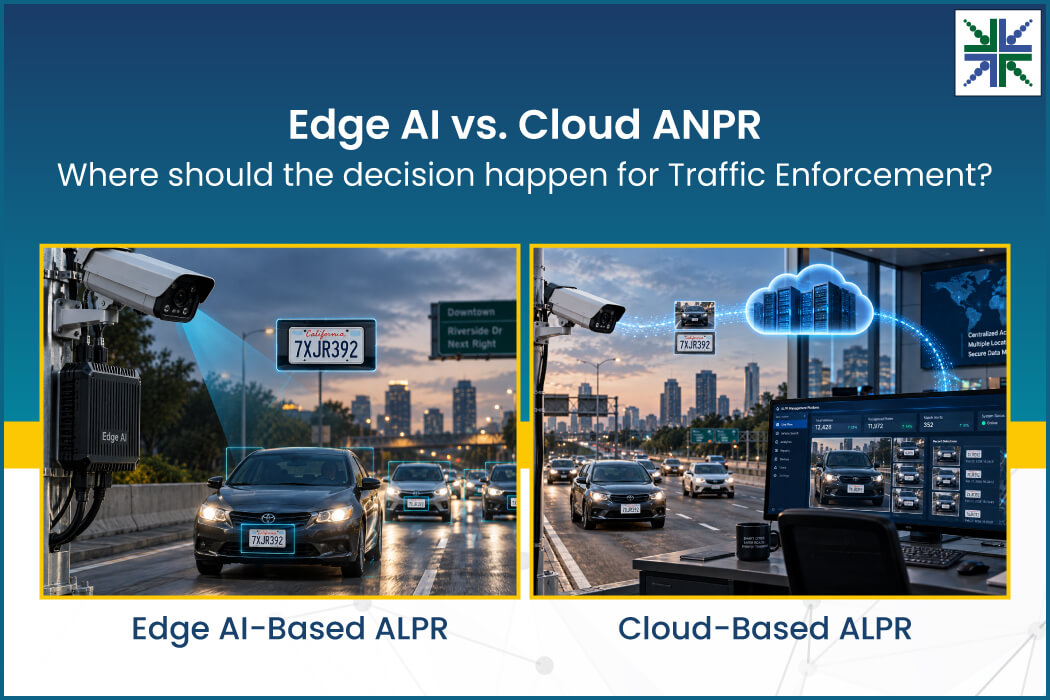
When a vehicle crosses the trigger point, the camera has a fraction of a second to capture the plate, process it and recognize it. Then, if it matches a watchlist or a violation, the system must act on this information. This timing pressure raises a critical question that every traffic enforcement system has to answer – should the intelligence exist on the roadside camera, or in the cloud?
Automatic Number Plate Recognition (ANPR) has become a regular fixture in modern traffic enforcement, from catching speed violators to managing toll lanes. Many ANPR deployments have traditionally used centralized servers to process images. Today, Edge AI is shifting that processing power directly onto the camera. For traffic enforcement officers, city planners, and system integrators, the choice between these two architectures affects everything from capture reliability to operational cost.
In this blog, you’ll find out what you need to know about edge AI-based ANPR vs. cloud-based ANPR, and why the real question isn’t which one wins, but where each one fits.
What is Edge AI–based ANPR?
Edge AI-based ANPR moves the recognition software onto the camera itself. Instead of streaming video to a remote server, the camera captures an image and processes it locally using an embedded processor and onboard AI algorithms.
In this setup, the camera acts as a standalone computer. It reads the license plate, checks it against a locally stored database, and makes an immediate decision – all within milliseconds. Only relevant data, such as a watchlist match alert, a time-stamped plate read, or an audit event, is sent onward to a central platform.
What is Cloud-based ANPR?
Cloud-based ANPR relies on a centralized processing model. The camera’s job is to capture images and stream them via Wi-Fi, cellular, or fiber to remote servers. Those servers run the Optical Character Recognition (OCR) software and return the results to the enforcement system.
This approach unifies computing power, making it easier to update algorithms or aggregate data across hundreds of cameras. But it also introduces a dependency. The camera can’t act until the cloud responds. In traffic enforcement, where vehicles move at high speed, a round trip to the cloud can be the difference between a clear plate read and a missed one.
Why Latency Matters in Traffic Enforcement Vision
At 70 mph, a vehicle travels roughly 100 feet per second. In a time-sensitive enforcement system, even small delays can matter, since triggering, capture, processing, and downstream decisioning all have to happen within a limited capture window.
Cloud-based ANPR adds network communication latency on top of processing time, and the actual delay depends on connectivity, routing, congestion, distance to the cloud, and the processing architecture itself. There is no fixed number.
NIST’s work on the edge-cloud continuum gives a concrete illustration. A remote cloud round trip can run 150 milliseconds or more in the worst case. It specifically identifies license-plate image processing for criminal tracking or toll collection as a use case that benefits from edge processing.
Edge AI removes the cloud network round trip from the critical inference path. This means that processing happens at the point of capture, so the plate-read decision doesn’t wait on a network call. It doesn’t mean edge processing has zero latency anywhere in the pipeline; camera processing time, triggering, and internal pipeline steps still exist. But for time-sensitive enforcement, removing the network hop from the decision path is an important advantage.
Watchlists: Local Decisioning Doesn’t Mean Isolated Systems
Processing locally raises an obvious question – how does the local watchlist stay current?
A stolen-vehicle or vehicle-of-interest list isn’t static, and a deployment of hundreds of cameras can’t rely on hundreds of independently maintained databases. In many deployments, watchlists and configuration data are synchronized from a central system down to edge devices.
The camera still makes the time-critical decision locally, while updates, audit information, and relevant events sync back to the central platform. This local intelligence for immediate decisions and centralized management for consistency and visibility is the balance that makes edge deployments practical.
The UK’s National ANPR Standards for Policing and Law Enforcement address local system resilience, local retention, transfer to national systems, and keeping vehicle-of-interest lists current. It illustrates the importance of keeping locally held VOI lists current in operational ANPR deployments.
Image Quality and ANPR Accuracy
Accuracy in ANPR depends on image clarity. Motion blur, poor lighting, headlight glare, and weather conditions all interfere with OCR.
Cloud-based systems can perform sophisticated image processing, but the captured image has to reach the remote processing environment first. And whatever quality issue exists in the frame travels with it. Edge AI allows image-quality assessment and ANPR processing to happen immediately at the point of capture, which means the camera can:
- Apply exposure and imaging controls based on scene and capture conditions
- Synchronize with infrared (IR) illumination for night-time capture
- Assess, select, or filter image frames based on defined quality criteria before downstream processing
- Apply region-specific formatting and character recognition rules locally
This local quality gate is crucial in traffic enforcement uses cases where unreliable plate reads can create false matches, manual-review workload, or downstream enforcement exceptions.
Deployment Scenarios of ANPR Cameras
- Fixed infrastructure: On highways, toll plazas, and intersections, cameras are permanently mounted and powered, often running 24/7 across multiple lanes at high speed. Edge processing ensures every vehicle is captured regardless of network availability, while the cloud can still aggregate data from multiple edge cameras for reporting and analytics.
- Mobile deployments: Patrol vehicles, temporary trailers, and mobile enforcement units face vibration, changing angles, and intermittent connectivity. A cloud-dependent system fails the moment a vehicle enters a tunnel or a cellular dead zone. Edge processing keeps the system running locally and syncs data once connectivity returns.
- Multi-site aggregation: Cloud-based processing makes sense when cameras are spread across many lower-priority locations, and real-time enforcement isn’t required. An example could be monitoring parking occupancy or tracking fleet vehicles across a city.
Why Hybrid Architectures Are Becoming Practical
Fixed, mobile, and multi-site scenarios point toward the same conclusion. Edge cameras can filter and act on time-critical events locally, while sending relevant plate reads and events to the cloud for centralized search, reporting, and fleet-wide intelligence. Rather than treating edge and cloud as competing options, most production ANPR systems end up combining them.
For instance, edge is chosen for decisions that can’t wait, and cloud is selected for analytics and management that don’t need to happen in real time.
Privacy and Data Management in ANPR Imaging
Edge processing can reduce the amount of sensitive video and plate data that needs to leave the roadside device, which can support more controlled data architecture depending on how the overall system is designed. But local processing on its own doesn’t resolve every data-management obligation like retention, access control, watchlist governance, transfer to central systems, audit, and lawful processing. These all still need to be designed into the system.
The UK’s National ANPR Standards explicitly cover data access, storage, transfer, deletion, and governance, underscoring that these are system-design questions, not something solved by architecture alone.
Edge AI vs. Cloud ANPR: Where Should the Decision Happen?
The question isn’t really “edge or cloud?” It’s “where does the decision need to happen?”
Here’s what you should consider:
- Real-time enforcement (speed violations, red-light enforcement, watchlist alerts) benefits from edge processing, because the decision can’t wait on a network round trip.
- Centralized analytics, fleet-wide search, and multi-site intelligence still have a strong case for the cloud.
- In many real-world deployments, the answer is both — edge for immediate decisions, cloud for centralized intelligence and management.
When evaluating an ANPR camera for traffic enforcement, look past sensor specs and ask where the processing happens, and how local decisions connect back to your central systems.
e-con Systems Offers New-Gen Edge AI ANPR Camera Solutions
e-con Systems® designs, develops, and manufactures embedded vision solutions from custom OEM cameras to complete ODM platforms. We have partnered with ANPR and ITS solution providers to build deployment-ready camera systems for real-world traffic enforcement. Our edge AI-ready cameras feature global shutter sensors to minimize rolling-shutter distortion, along with ruggedized enclosures built for years of roadside operation, and native support for IR strobes, radar triggers, and Linux software stacks.
Visit our Camera Selector Page to explore our full portfolio.
Exploring edge AI ANPR architecture for your traffic or enforcement application? Write to camerasolutions@e-consystems.com to discuss customization, optics, triggering, and system integration.
FAQs
What is the difference between Edge AI-based ANPR and Cloud-based ANPR?
Edge AI-based ANPR processes images locally on the camera using embedded processors and onboard AI algorithms, enabling instant decisions. Cloud-based ANPR sends images to remote servers for processing, which introduces latency due to data transmission and round-trip waiting times.
Does Edge AI eliminate network latency in ANPR?
Edge AI removes the network round trip from the critical inference path, since the plate-read decision happens at the camera. It doesn’t eliminate every source of latency in the system — camera processing, triggering, and internal pipeline steps still take time — but it removes the network hop from the time-critical decision.
Can Edge AI ANPR work without continuous connectivity?
Yes. Because recognition happens locally, edge cameras can continue capturing and processing plates during network outages or in low-connectivity environments like tunnels or rural corridors, syncing data once connectivity returns.
How are ANPR watchlists updated on edge devices?
In many deployments, watchlists and configuration data are synchronized from a central system to edge devices on a regular basis. The camera still makes time-critical decisions locally, while updates and audit events sync back to the central platform.
Is Edge AI or cloud ANPR better for traffic enforcement?
It depends on the function. Edge AI fits real-time enforcement — speed violations, red-light enforcement, watchlist alerts — where the decision can’t wait on a network call. Cloud infrastructure remains valuable for centralized analytics, fleet-wide search, and multi-site intelligence.
Can Edge AI and cloud ANPR be used together?
This hybrid architecture is common in production ANPR deployments. Edge cameras handle the time-critical decision locally and send relevant events to the cloud for centralized search, reporting, and management.

Dilip Kumar is a computer vision solutions architect having more than 8 years of experience in camera solutions development & edge computing. He has spearheaded research & development of computer vision & AI products for the currently nascent edge AI industry. He has been at the forefront of building multiple vision based products using embedded SoCs for industrial use cases such as Autonomous Mobile Robots, AI based video analytics systems, Drone based inspection & surveillance systems.