



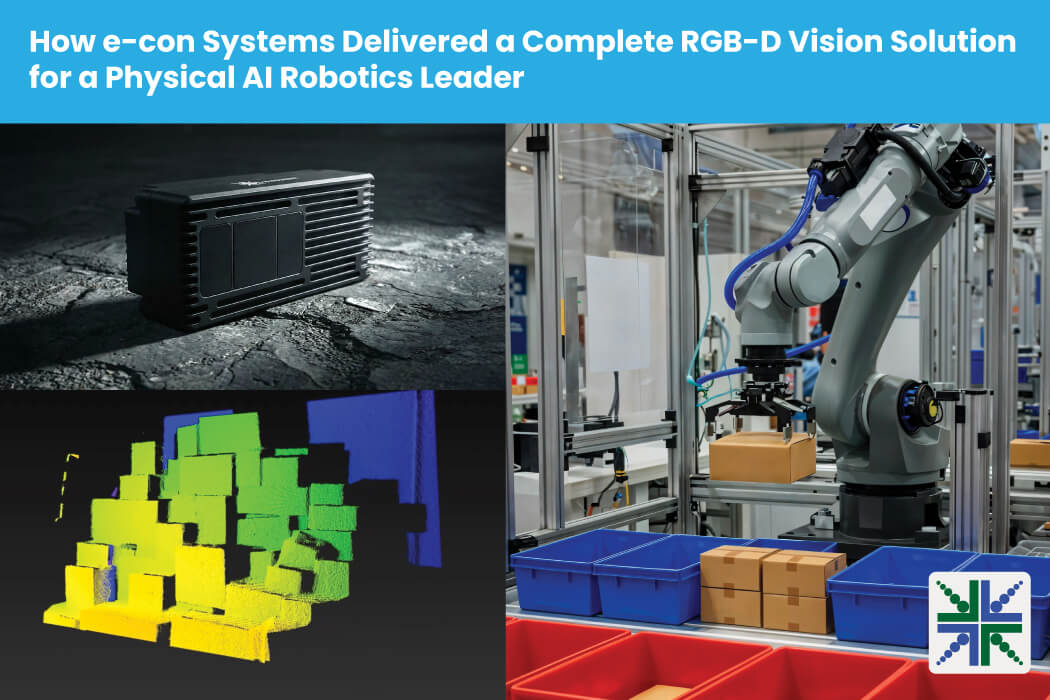
Physical AI is moving fast from lab demos to production floors, but it only works if robots can perceive the world with human-like precision. For a robotic arm picking thousands of unique objects an hour, depth perception is measured in millimeters. And so, even a few millimeters of error can mean a failed pick, a dropped package, or a stalled line.
Physical AI companies scaling robotic manipulation face hardware precision, software efficiency, multi-camera synchronization, and configurability challenges all at once.
A renowned Physical AI company ran into exactly this wall. So they required an RGB-D vision system that could deliver precise, synchronized depth data at production scale, something off-the-shelf sensors simply couldn’t provide.
e-con Systems worked closely with them to select and deploy a suitable vision solution.
What Challenges Were Faced By Our Client?
The client’s robots operate autonomously across large-scale logistics and supply chain environments, making millions of decisions with zero safety incidents. Hitting that bar meant solving for:
- Depth accuracy tight enough for fine-grained robotic manipulation, not just general-purpose sensing
- SDK performance that placed a heavy CPU load and slowed data transfer, limiting real-time processing
- No built-in way to synchronize multiple cameras for wide-area, multi-camera deployments
- Limited configurability for post-processing, status monitoring, and real-time tuning
- Off-the-shelf hardware that couldn’t meet stringent noise and accuracy specifications at scale
How e-con Systems Delivered a Custom RGB-D Vision Solution
e-con Systems developed a complete, production-ready RGB-D vision platform, pairing custom camera hardware with deep SDK optimization and close hardware-software co-development.
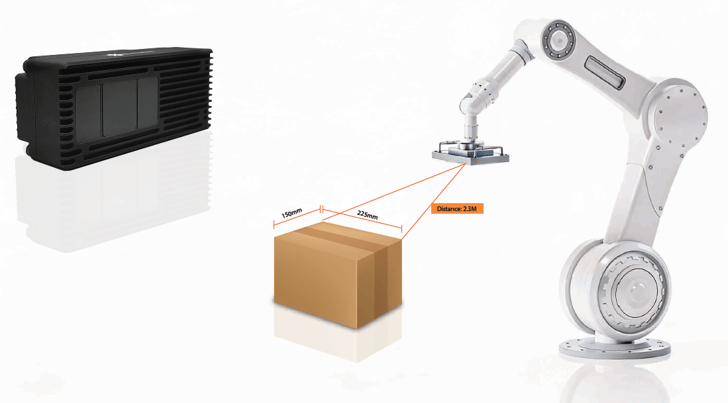
The highlights of the solution were:
- Custom RGB-D camera board: A ToF depth sensor, RGB image sensor with ISP, and FPGA for signal processing, integrated with a GMSL serializer for long-cable transmission and an onboard IMU
- Multi-camera system architecture: A custom GMSL-to-PCIe Frame Grabber board streaming from up to 8 cameras over PCIe Gen3 x4, with groups of four cameras consolidated through GMSL deserializers and an FPGA
- SDK performance optimization: Reduced CPU load and faster data transfer, letting the client’s robotics platform process depth data in real time without overloading edge compute resources
- Depth precision: ±5 mm depth deviation validated from 0.5 m to 4 m, meeting the client’s 1% error margin at close range and 3% error margin in WDR mode
- Multi-camera synchronization: Consistent timing and data coherence across all 8 camera streams, plus interference cancellation for simultaneous multi-camera operation
- Advanced configurability: Post-processing filters for depth quality, LED indicators for camera status, and real-time parameter tuning for dynamic scenes
Learn how e-con Systems’ Custom RGB-D Vision Platform Delivered Superior Robotic Manipulation in Physical AI
Business Benefits of Our RGB-D Vision Solution
- Reliable, stable operation through improved frame rate management and memory handling, with zero runtime allocation and zero fragmentation
- Richer spatial understanding through RGB-D mapping, directly supporting precision manipulation and navigation
- High-quality 3D data through point-cloud noise reduction, improving downstream object recognition accuracy
- Long-term deployment confidence through firmware hardening and sustained post-release software support, lowering long-term engineering overhead
Curious about how this custom RGB-D vision system came together for precision robotic manipulation?
If you’re working on a similar Physical AI or robotics imaging application, get valuable insights from the team behind this RGB-D vision solution. For more information, write to camerasolutions@e-consystems.com

Prabu is the Chief Technology Officer and Head of Camera Products at e-con Systems, and comes with a rich experience of more than 15 years in the embedded vision space. He brings to the table a deep knowledge in USB cameras, embedded vision cameras, vision algorithms and FPGAs. He has built 50+ camera solutions spanning various domains such as medical, industrial, agriculture, retail, biometrics, and more. He also comes with expertise in device driver development and BSP development. Currently, Prabu’s focus is to build smart camera solutions that power new age AI based applications.