



A surveillance drone can reach the right place at the right time, yet the final image still has to carry enough detail for people and software to understand what happened. While surveillance drones have changed how teams inspect large sites, monitor public spaces, and more, their ability to help make informed decisions depends on the imaging performance of embedded vision systems.
Every frame a drone captures during a surveillance mission translates into actionable intelligence. The clarity of that frame and the accuracy of its timing can be the difference between catching an issue early and missing it entirely. As drone applications grow more demanding, two imaging features, namely high-resolution imaging and global shutter technology, have emerged as critical for surveillance deployments.
Understanding why they matter and how they complement each other is important for anyone building a future-proofed drone-based surveillance system.
In this blog, you’ll learn more about how surveillance drones work, why the above-mentioned features are important, and how to navigate the camera selection process.
Why Vision Is Harder Than It Looks for Surveillance Drones
A surveillance drone rarely captures a calm scene from a fixed position. It climbs, turns, hovers, descends, and changes viewing angles while recording people, vehicles, equipment, fences, rooftops, and site boundaries. Each captured frame has to preserve relationships between objects. For example:
- A vehicle should hold its actual shape
- A fence line should remain straight
- A person moving through the scene should appear as a person, rather than a stretched or skewed form
In more dynamic scenarios, like tracking moving inventory in a warehouse or monitoring live activities across a large outdoor site, the camera must perform reliably under constant motion at varying altitudes.
This results in challenges, such as:
- Limited scene detail when the drone operates at height
- Motion blur or distortion when the drone, subject, or both are moving
- Frame capture demands that match the pace of the application
- Loss of fine visual cues needed to distinguish small objects, markings, labels, or surface changes from a distance
- Inaccurate object edges and scene geometry during speed or viewing-angle changes
- Lower frame usability during rapid flyovers, close passes, or sudden repositioning
Why Surveillance Drones Need High Resolution Imaging
High resolution is crucial when a drone has to cover an area and still retain details that matter later. The person reviewing the footage may need to inspect a gate, identify a change in equipment position, compare vehicle movement across patrols, or document site condition after an event. Wide-area coverage has limited value when every meaningful detail disappears during zoom.
In practical surveillance workflows, high resolution helps by:
- Extracting more scene information in each frame, preserving object boundaries, surface details, and visual context across broad views
- Improving post-flight review because personnel can crop or zoom into relevant areas while retaining more usable detail
- Empowering analytics to separate people, vehicles, equipment, and structures when subjects occupy a small portion of the frame
- Reducing repeated flights caused by footage that covers the area but lacks inspection-ready detail
- Delivering visual records for audits, incident timelines, site documentation, and routine monitoring
High pixel count works best when paired with a global shutter sensor. In that setup, a single flight can capture the overview needed for situational awareness and the detail needed for later inspection.
How Global Shutter Technology Helps Surveillance Drones
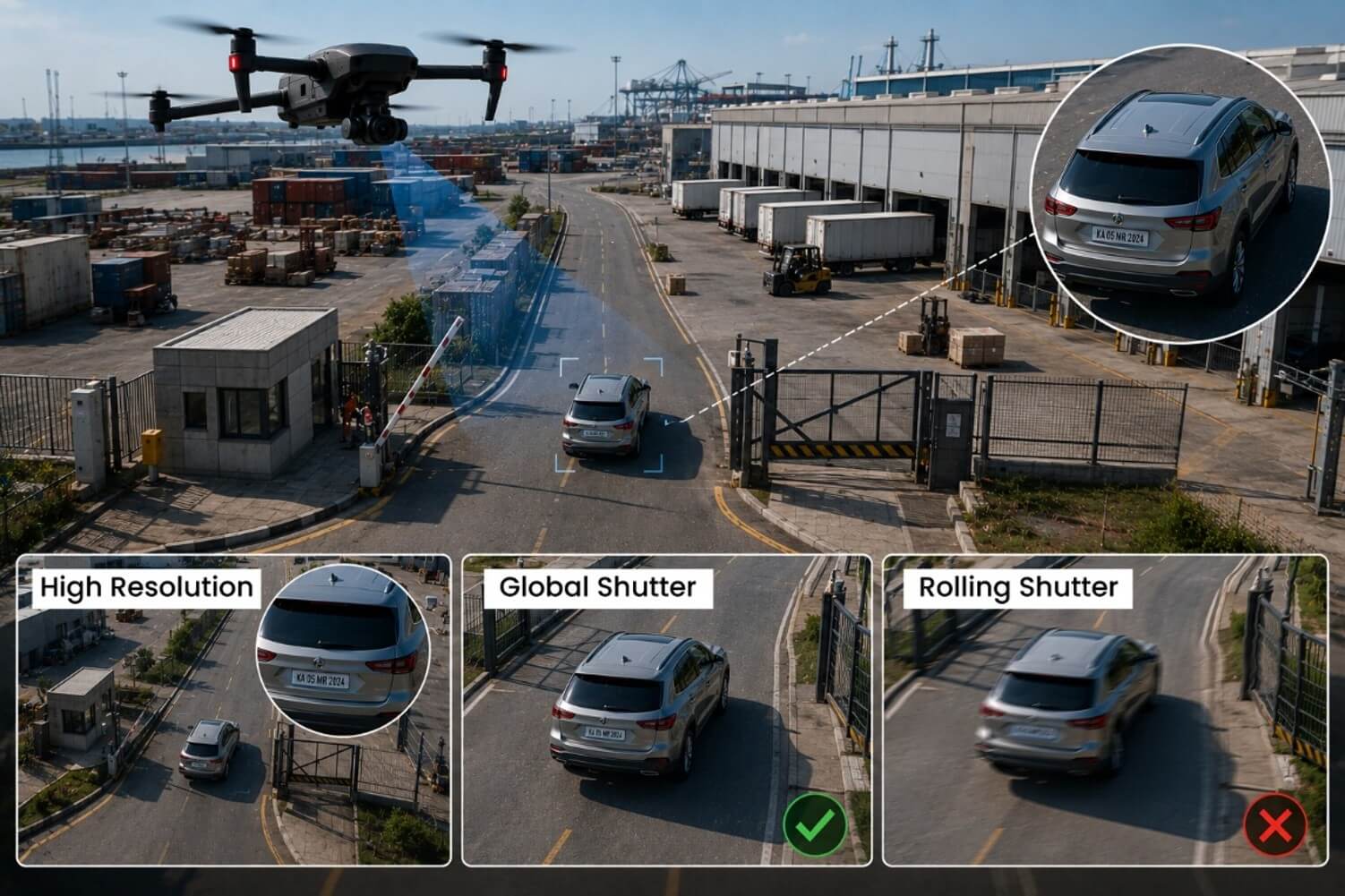
Rolling shutter cameras read an image line by line, which can distort objects when movement occurs during frame capture. Global shutter cameras expose all pixels at the same moment, so the top, middle, and bottom of the frame represent one instant.
In modern surveillance, that timing is pertinent because footage may be reviewed frame by frame. For instance, a vehicle crossing the field of view or a person walking near a gate should appear with geometry that matches the real scene. During fast drone movement, rolling shutter capture can introduce skew, wobble-like deformation, and shape changes because different rows record the subject at slightly different moments. Global shutter reduces these artifacts by capturing the complete frame at once.
Subject distance also affects how visible these distortions become. Objects close to the drone move across more pixels within a given period, creating higher apparent motion even when their physical speed remains unchanged. Nearby vehicles, fences, equipment, and people can therefore show stronger skew or stretching in rolling shutter footage.
Global shutter is better suited to these close-range scenes because it preserves object geometry during rapid relative movement.
Rolling shutter artifacts may be less visible when the drone observes faraway, slow-moving objects or follows a gradual flight path. However, as the drone approaches the subject, changes direction, or rotates, apparent motion increases and distortion becomes easier to see. This makes subject distance an important factor when selecting a camera.
Generally, global shutter cameras are well suited to drone surveillance paths involving:
- Fast forward motion
- Rotation or sudden direction changes
- Close-range passes over people, vehicles, or equipment
- Frequent changes in subject distance
- Frame-by-frame review
How to Choose the Right Surveillance Drone Camera
Choosing a drone vision system should begin with the visual task. A practical evaluation should focus on:
- Matching the resolution to the viewing distance, because subjects captured from height need enough pixels on target for review and analysis
- Leveraging global shutter technology for flight paths with quick movement, rotation, vibration, or moving subjects inside the scene
- Testing footage using real patrol routes, since lab images rarely expose the same motion and distance issues that appear during field operation
- Reviewing the still frames from video, because surveillance decisions often depend on a single captured moment
- Assessing how much detail remains after cropping, since post-flight review often focuses on only one portion of a wide scene
e-con Systems Offers Proven Cameras for Modern Surveillance Drones
Since 2003, e-con Systems has been designing, developing, and manufacturing custom OEM and ODM cameras for various industries like smart surveillance. With unparalleled camera engineering expertise, we work with product teams to meet their application’s real-world conditions.
See all our smart surveillance vision solutions
Please use the Camera Selector to effortlessly explore all our camera solutions based on specific parameters.
If you’re looking to build or upgrade your smart surveillance system and need expert insights on the vision power you need, write to us at camerasolutions@e-consystems.com.
FAQs
1) Why do surveillance drones need high-resolution cameras?
Surveillance drones often capture wide areas from height. High resolution cameras help retain object boundaries, surface details, markings, and visual context, so teams can review footage, crop into areas of interest, and analyze scenes with more confidence.
2) How does global shutter help drone surveillance footage?
Global shutter captures the full frame at the same instant. This helps reduce skew, shape distortion, and motion-linked artifacts when the drone moves quickly, changes angle, rotates, or records moving subjects.
3) What makes vision difficult for surveillance drones?
A surveillance drone rarely records from a fixed position. It climbs, turns, hovers, descends, and changes viewing angles while capturing people, vehicles, fences, rooftops, equipment, and site boundaries. These movements can affect object shape, scene geometry, and frame usability.
4) What should teams consider when choosing a camera for surveillance drones?
Teams should match resolution to viewing distance, evaluate global shutter for routes with motion or vibration, test footage on real patrol paths, review still frames from video, and check how much detail remains after cropping.
5) Why are still frames important in drone surveillance video?
Surveillance decisions often depend on a single captured moment. A usable still frame can help teams inspect a gate, review vehicle movement, compare site changes, document an incident, or build an audit trail from recorded footage.

Ram Prasad is a Camera Solution Architect with over 12 years of experience in embedded product development, technical architecture, and delivering vision-based solution. He has been instrumental in enabling 100+ customers across diverse industries to integrate the right imaging technologies into their products. His expertise spans a wide range of applications, including smart surveillance, precision agriculture, industrial automation, and mobility solutions. Ram’s deep understanding of embedded vision systems has helped companies accelerate innovation and build reliable, future-ready products.