



Key Takeaways
- Why camera coverage needs to match the evidence gap behind a collision
- Types of cameras that contribute to accident reconstruction
- How to select the right camera based on fleet type, road conditions, risk, coverage, etc.
- How e-con Systems’ ITS camera capabilities support post-accident analysis
No camera covers every angle, and this is not a limitation that can be engineered away with a single device. For instance, a windshield-mounted unit records what the driver saw but tells investigators nothing about what approached from behind. In the case of a cabin-facing camera, it captures behavioral data but has no view of the external environment at the moment of impact.
Developing a complete, verifiable account of a collision means assigning the right camera type to each investigative gap it was meant to close.
In this blog, you’ll learn about the seven types of cameras used in post-accident investigation, their typical deployments, and what they contribute to post-accident investigation.
What Are the Types of Cameras for Post-Accident Investigation?
The most in-depth investigations use crash reconstructions that draw on overlapping sources.
They pull footage from inside the cab, from the vehicle perimeter, and from fixed infrastructure at points along the corridor where the incident occurred.
Each camera type addresses a distinct investigative need, with others compensating for its blind spots. This ensures critical aspects of a collision are recorded from complementary viewpoints.
- In-vehicle forward-facing cameras: These cameras let investigators verify road conditions and vehicle movement immediately before the crash, supporting assessments of hazard visibility, traffic signals, and driver reaction time.
- Cabin-oriented driver monitoring cameras: Driver monitoring cameras help confirm driver awareness, track gaze, and detect distraction or fatigue, giving investigators details on operator behavior before impact.
- Rear-view/moving-off cameras: These cameras increase visibility in blind spots, offering evidence to resolve incidents involving reversing or low-speed maneuvers and clarifying the positions of trailing vehicles and pedestrians.
- Fixed ANPR infrastructure cameras: ANPR cameras contribute independent records of vehicle identity, timestamps, lane position, and, in some deployments, speed data, helping investigators reconstruct events and link vehicles to incident sites.
- Thermal cameras: They provide clear imagery, including in darkness or difficult conditions, allowing investigators to detect people and vehicles when standard optics are ineffective.
- Surround-view camera systems: These systems bring together front, rear, and side camera views to develop a synchronized 360° scene reconstruction around vehicles. This helps investigators review side impacts, lane changes, parking damage, and junction maneuvers.
- Telematics-integrated cameras: These cameras synchronize visual evidence with vehicle dynamics data, supporting precise reconstruction and quantifying driver actions during a collision.
Now, let’s explore them, one by one:
Front-facing cameras
Front-facing cameras are often the first source checked after a collision because they show the road from the driver’s line of travel. Mounted near the windshield or front bumper, they capture lane markings, signal states, road surface issues, pedestrians, and the movement of vehicles ahead.
This view helps investigators understand whether a hazard appeared suddenly or had been visible for several seconds. It also helps confirm
This view helps investigators understand whether a hazard appeared suddenly or had been visible for several seconds. It also helps confirm traffic signal states, approach angles, and evasive action. With global shutter sensors, fast-moving objects are captured without rolling shutter distortion.
Advanced units may also tag hard braking, swerves, and proximity events, giving teams a faster way to locate relevant moments in the footage.
Driver monitoring cameras
Driver monitoring cameras face the operator rather than the road. They track gaze direction, head pose, eyelid closure, and other fatigue or distraction markers. This matters because physical damage can show what happened, but it rarely explains if the operator was attentive before impact.
Signs of micro-sleep or head position changes can support or challenge claims about sudden hazards. Near-infrared illumination keeps cabin tracking reliable in darkness.
Along with telematics data, driver behavior can be correlated with braking, steering, and acceleration inputs from the same moment.
Rear-view/moving-off cameras
Rear-view/moving-off cameras cover the space behind a vehicle, where visibility gaps are larger for trucks, buses, and other heavy vehicles. They capture reversing movement, approaching traffic, low obstacles, cyclists, and pedestrians in the trailing area.
Moving-off cameras are complementary types that extend coverage to the front blind area during low-speed starts at junctions.
This footage is valuable because rear-impact and reversing incidents frequently become disputes about the sequence of events. The footage can show if the following vehicle was decelerating or if a pedestrian entered the area before movement began.
ANPR cameras
ANPR cameras are fixed infrastructure units deployed at roadside locations such as junctions, entry points, gantries, toll areas, and high-risk corridors. They capture number plates and pair them with timestamps, lane position, and, in some deployments, speed data derived from paired radar sensors, average-speed systems, or video analytics.
ANPR creates a vehicle trail independent of witness memory. It can confirm that a vehicle has passed through a location, identify a hit-and-run suspect, and trace a vehicle’s route across road segments before or after a crash.
Features such as high-resolution optics, high capture frame rate, and controlled illumination help capture readable plates at high vehicle speeds.
Thermal cameras
Thermal cameras detect infrared radiation emitted by people, vehicles, and objects. Because they rely on heat rather than visible light, they remain useful when darkness, glare, fog, rain, or low contrast impair the effectiveness of standard optical sensors.
In a post-accident review, a thermal unit can show a pedestrian walking onto the road, a stationary vehicle on an unlit shoulder, or residual heat signatures from a recently active engine. It can also help determine whether a vehicle’s engine was recently active. In fog-related pileups, thermal cameras may provide the clearest view of the scene.
Surround-view camera systems
Surround-view systems combine front, rear, and side modules to create a 360-degree view around the vehicle. Instead of relying on one angle, investigators can review how nearby vehicles, pedestrians, or objects moved around the subject vehicle.
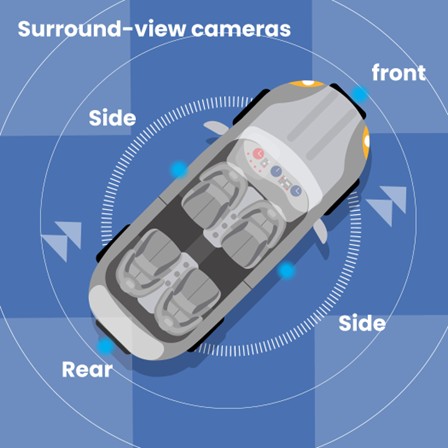
Surround-view systems combine front, rear, and side modules to create a 360-degree view around the vehicle. Instead of relying on one angle, investigators can review how nearby vehicles, pedestrians, or objects moved around the subject vehicle simultaneously.
The system is useful for side-impact collisions, lane changes, parking incidents, and junction maneuvers. The shared timeline helps review synchronized angles, which reduces guesswork in complex incidents.
Telematics cameras
Telematics cameras connect video with GPS, accelerometer, gyroscope, and CAN bus data. This links the frames with speed, heading, g-force, braking intensity, steering angle, and location data.
When a collision trigger is detected, the system can save the pre-crash and post-crash sequence before loop recording overwrites it. The added data helps quantify what the footage shows, such as how hard the vehicle braked.
Repeated patterns across the fleet can reveal risky routes or identify drivers who need coaching.
How to Choose the Right Camera Combo for Accident Investigation
The best camera setup depends on vehicle type, route, and risk profile. Urban buses, taxis, and delivery fleets usually need perimeter coverage, cabin monitoring, and telematics, with front-facing views helping capture key moments at junctions or pedestrian crossings.
Highway and long-haul operations prioritize front-facing and rear-view cameras, supported by ANPR and telematics for speed and location checks.
On rural or unlit routes, thermal imaging becomes more valuable because standard optical sensors lose effectiveness in low-light conditions. Fixed roadside deployments usually combine ANPR, optical, and thermal units so investigators can review identity, movement, and environmental conditions from the same corridor.
e-con Systems’ Cameras for Post-Accident Analysis
e-con Systems has been designing, developing, and manufacturing embedded vision cameras since 2003. Our ITS cameras deliver superior imaging with features like global shutter, HDR, low-light optimization, and multi-camera synchronization. They also come with rugged IP-rated enclosures that meet compliance standards such as NEMA-TS2, FCC Part 15, NDAA, and BABA compliance.
Curious about which camera is right for you? Visit our Camera Selector Page to browse our complete portfolio.
Need help choosing the ideal camera solution for your smart traffic setups? Please write to camerasolutions@e-consystems.com.
FAQs
- Which camera types are used in post-accident investigation?
Front-facing cameras, driver monitoring cameras, rear-view cameras, ANPR cameras, thermal cameras, surround-view camera systems, and telematics-integrated cameras all support different parts of crash reconstruction. Each one captures a different evidence layer, from road view and driver behavior to plate data, speed, blind spots, and low-light visibility.
- Why are front-facing cameras useful after a crash?
Front-facing cameras show what happened ahead of the vehicle before impact. They verify traffic signal states, road conditions, pedestrian movement, nearby vehicles, and the driver’s forward field of view during the moments leading up to the incident.
- How do driver monitoring cameras support accident analysis?
Driver monitoring cameras capture gaze direction, head position, eyelid movement, and signs of fatigue or distraction. This helps determine whether the driver was attentive, drowsy, distracted, or facing away at the critical moment.
- When are thermal cameras useful in post-accident investigations?
Thermal cameras are useful at night, in fog, heavy rain, headlight glare, and other low-visibility conditions. They can reveal pedestrians, stalled vehicles, obstacles, and heat signatures that standard cameras may miss.
- Why combine video with telematics data?
Telematics-integrated cameras connect footage with GPS, accelerometer, gyroscope, braking, steering, and CAN bus data. Hence, investigators can match what the video shows with measurable vehicle behavior, such as speed, impact force, heading, and braking response.

Dilip Kumar is a computer vision solutions architect having more than 8 years of experience in camera solutions development & edge computing. He has spearheaded research & development of computer vision & AI products for the currently nascent edge AI industry. He has been at the forefront of building multiple vision based products using embedded SoCs for industrial use cases such as Autonomous Mobile Robots, AI based video analytics systems, Drone based inspection & surveillance systems.