



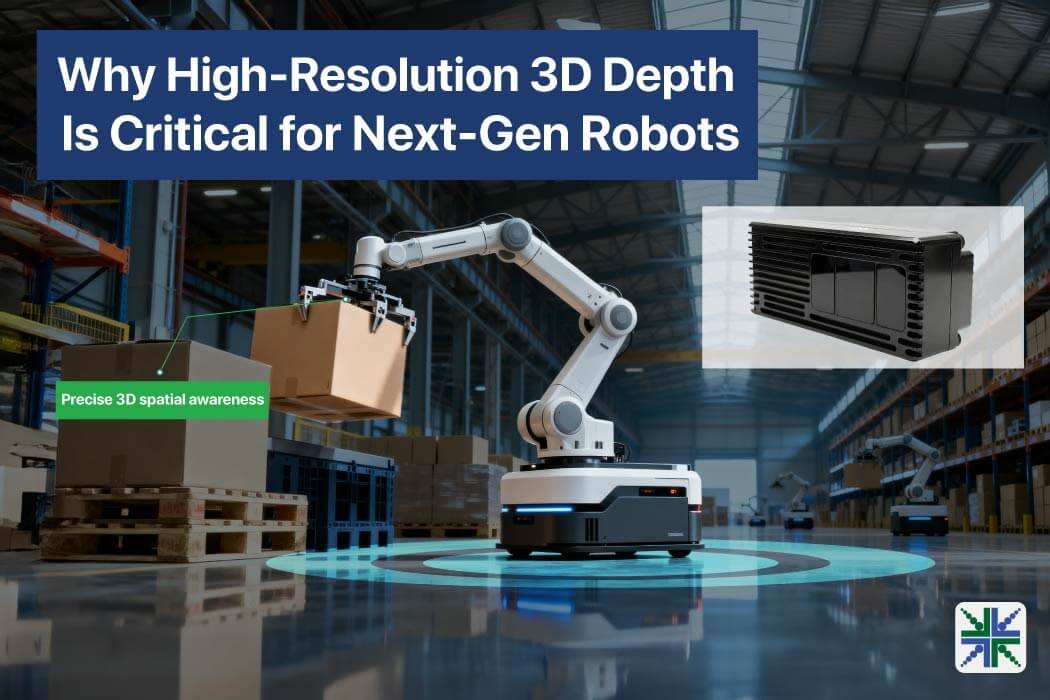
When discussing 3D depth cameras, “high-resolution” refers to a sensor’s ability to capture a dense, detailed map of distance measurements. Specifically, it means the sensor provides more individual data points, or pixels, across its field of view. For example, a camera offering 1280×960 resolution delivers more pixels than a traditional VGA (640×480) sensor.
The practical impact of this increased pixel count is straightforward: each pixel represents a smaller, more precise slice of the observed scene. This higher spatial resolution reduces the angular width of each pixel’s field of view. Consequently, fine physical details in the environment are sampled more accurately, eliminating the large data gaps that cause robotic systems to miss critical spatial information.
In this blog, you’ll learn why high-resolution 3D depth-based imaging is crucial for next-generation robots to see, understand, and take action.
Why More Pixels in a 3D Camera Make Next-Gen Robots Smarter
- At 2-3 meters, small objects register as distinct objects rather than being missed entirely. The higher number of pixels means the environment is sampled more thoroughly, preventing small or narrow items from falling into the data gaps of a lower-resolution sensor.
- Thin objects like rack edges or poles are far less likely to fall between pixels. The angular width of each pixel field of view is smaller, so fine vertical structures are captured in the depth image instead of disappearing.
- Sub-millimeter depth precision becomes possible. This high level of detail allows the system to detect the slight height difference at the seam between two closely stacked boxes, enabling the robot to identify them as separate items.
- The increased pixel density improves the accuracy of other sensor functions. With more precise data points, features like multipath rejection and confidence scoring can operate with greater reliability, filtering out noise more effectively.
- It enables more reliable detection at a robot’s operational range. The combination of dense sampling and stable long-range measurement ensures that objects are clearly defined not just up close, but at the distances where AMRs navigate and plan paths.
How High-Resolution 3D Depth Works with Other Features
- Effective material-based settings: The sensor can store pre-configured exposure settings for different material properties, such as Dark Rubber and Shiny Metal. The detailed depth data ensures these modes accurately capture the unique surface geometry of each material type.
- Improved reflection filtering: In environments with reflective floors or parts, multipath reflections distort signals. The denser pixel data lets the system accurately identify and flag these distorted pixels with low confidence scores, enabling the robot to filter them out and ignore false obstacles.
- Extended operational range: The higher pixel density works in tandem with dual-frequency operation. This improves signal stability at longer distances, enabling precise navigation and obstacle detection across larger areas like warehouse floors.
Benefits of High-Resolution 3D Depth for Next-Gen Robots
Accurate obstacle detection for safe navigation
In the busy corridors of a warehouse, robots need to see every potential hazard. A standard-resolution depth camera might miss a thin vertical rack edge or a narrow pole because it falls into the gap between pixels. With a high-resolution 3D camera, these fine details are captured clearly.
The increased pixel density ensures the robot perceives thin structures as solid objects, making sure it can navigate around them confidently and avoid collisions.
Precision for delicate material handling
Robots tasked with picking items from bins often face a mix of materials, from dark, light-absorbing rubber to highly reflective metal parts. A single sensor setting cannot accurately gauge the depth of both, leading to misjudged grip heights and damaged equipment. High-resolution 3D depth enables the use of programmable settings for different material properties.
The system can instantly switch to an optimized mode, capturing accurate depth for a shiny metal component immediately after scanning a dark rubber part.
Consistent picking performance
During depalletizing, a robot must discern whether it’s facing one tall box or two boxes stacked closely together. A low-resolution depth reading might present them as a single, continuous object. The sub-millimeter precision afforded by high-resolution 3D sensing detects the minute height difference at the seam between the boxes.
This equips the robotic system to correctly identify separate items, ensuring accurate counting, sorting, and placement, which is critical for inventory management and fulfillment accuracy.
Reliability in complex environments
Factories and outdoor settings are full of visual noise like reflections from polished floors, glare from windows, and signals bouncing off shiny surfaces. These conditions generate false depth readings that can trick a robot into seeing obstacles that aren’t there. High-resolution 3D data works in concert with confidence scoring.
The system can identify and flag the low-confidence pixels created by these reflections. By filtering out this unreliable data, the robot bases its decisions only on trustworthy depth information, maintaining operational integrity in challenging, real-world conditions.
e-con Systems’ DepthVista Helix is a High-Resolution 3D iToF Camera
e-con Systems has been designing, developing, and manufacturing OEM cameras since 2003. DepthVista Helix is our latest Time-of-Flight (iToF) GMSL camera module for accurate 3D depth measurement. This camera uses the onsemi Hyperlux™ ID AF0130 CMOS sensor to deliver high-resolution depth data at 1.2MP @ 60fps and VGA @ 30fps for real-time 3D applications – with dual laser operation that extends the depth range at VGA resolution.
DepthVista Helix ensures a high accuracy depth range of 0.2m to 6m with <1% deviation. It excels in challenging lighting with superior low-light and ambient light performance. This camera also has integrated laser eye safety monitoring, as well as an IP67-rated enclosure.
Explore e-con Systems’ ToF cameras
Please visit our Camera Selector Page to browse our entire portfolio.
Interested in knowing more about how DepthVista Helix can help your embedded vision application overcome unique challenges? Get in touch with our camera experts by writing to camerasolutions@e-consystems.com.
FAQs
- What does “high-resolution” mean in a 3D depth camera?
High-resolution in 3D depth means the sensor captures a denser map of distance values, with more pixels across the field of view. A 1280×960 depth output contains more data points than VGA at 640×480. Each pixel covers a smaller slice of the scene, so the depth map carries more detail.
- Why do more pixels matter at the distances where robots move and plan paths?
At around 2–3 meters, small objects register as distinct items instead of blending into gaps in the depth data. The scene gets sampled more thoroughly, so narrow items show up more consistently. This helps navigation and path planning at typical AMR operating distances.
- How does high-resolution depth reduce misses on thin hazards like rack edges or poles?
Thin hazards can slip through when a depth camera has fewer pixels and larger gaps between sampled points. With higher pixel density, the angular width per pixel shrinks, so thin vertical structures land on more pixels. That makes poles, bars, and rack edges appear as solid obstacles in the depth image.
- How does high-resolution depth help during depalletizing and picking stacked boxes?
During depalletizing, two boxes stacked close together can look like one continuous object with lower-resolution depth. High-resolution 3D sensing can detect the small height change at the seam between the boxes. That gives the robot better separation for counting, sorting, and placement.
- How does high-resolution depth work with reflection filtering and material-based settings?
Reflective floors and shiny parts can create false depth readings due to multipath reflections, and the sensor flags these pixels with low confidence scores for filtering. High-resolution depth gives more detailed pixel data, which improves the reliability of confidence scoring and multipath rejection. The sensor can store pre-configured exposure settings for different material properties such as dark rubber and shiny metal, so a robot can switch modes when bins contain mixed materials.

Prabu is the Chief Technology Officer and Head of Camera Products at e-con Systems, and comes with a rich experience of more than 15 years in the embedded vision space. He brings to the table a deep knowledge in USB cameras, embedded vision cameras, vision algorithms and FPGAs. He has built 50+ camera solutions spanning various domains such as medical, industrial, agriculture, retail, biometrics, and more. He also comes with expertise in device driver development and BSP development. Currently, Prabu’s focus is to build smart camera solutions that power new age AI based applications.