



A robotic camera choice goes far past the module mounted on the machine. Its lens, sensor, image signal processor and interface establish the visual data that enters perception software. They also influence the electrical route to the compute platform and the spatial relationship between the camera and every other sensor.
When the prototype starts to move, the engineering teams then begin to build based on those conditions.
At this stage, replacing the module would involve looking at each of the dependencies that have developed around it, a process which could be time-consuming and, in the end, expensive.
In this blog, you’ll find out why matching specifications provide limited reassurance, which software and hardware decisions must be reopened, and more.
Camera Specifications Don’t Tell the Full Story – Here’s Why
Two camera modules can have the same resolution and frame rate figures but still produce different processed images. The application gets the output after the sensor data has been processed by the ISP; the sensor selection determines the starting point, and the ISP configuration shows which frames are used for AI inference and metric measurement.
The Same Sensor Can Produce Different Application Input
ISP settings impact the brightness, contrast, color, sharpness and noise characteristics presented to the software. A replacement using the same sensor can perform differently if its image pipeline uses another configuration. The detector, barcode engine or measurement pipeline then receives visual input that differs from the material used during development.
(Watch our recent webinar that showcases this using a dock door example)
HDR has to preserve detail in both the bright opening and the darker load, and at the same time, control motion artifacts; exposure needs to adjust as the robot crosses the lighting boundary, and white balance has to deal with the color changes that occur under mixed illumination.
ISP Change Can Solve One Problem, But Create Another
Aggressive noise reduction can produce a smoother image while removing features used by the AI model. Distortion correction can improve measurements despite adding latency. Tone mapping must serve AI processing and teleoperation video, which may place different demands on the same camera output.
These relationships make visual similarity a weak replacement criterion. The more appropriate comparison would be between the processed outputs delivered to the workload when the robot is operating under the actual conditions it encounters. As a result, a decision to replace will have to involve a comparison at the application level of both camera pipelines.
What Developers Must Consider After Camera Replacement
Training data and software assumptions
The original image configuration becomes part of the AI training data. A different camera or ISP configuration can change the visual characteristics supplied to the model, which may lead to AI retraining. The software team must determine how the new output affects the inference pipeline rather than relying on the module specification sheet.
The same review applies to image-dependent tasks outside object detection. Barcode reading requires sufficient pixels on the label and control over motion blur. Teleoperation depends on low glass-to-glass latency, while metric measurement demands clear image geometry.
So, the replacement must be judged against the task that placed the highest demand on the original camera.
Intrinsic and extrinsic calibration
Intrinsic calibration describes the camera internally. Extrinsic calibration defines its relationship with the robot and the other sensors. A module replacement can change the optical configuration or installed relationship represented by those records, which brings calibration work back into the program.
This dependency becomes visible during sensor fusion. Each reading must be placed in one coordinate frame before association links measurements belonging to the same object. If the camera identifies a pedestrian – with LiDAR supplying info on distance and radar on speed, the fusion pipeline needs the camera measurement to agree spatially with the other inputs.
Carrier Board and Interface Architecture
A direct MIPI CSI-2 camera provides a low-cost, low-latency route to the SoC, though the webinar places its reach at roughly 30 centimeters. This connection suits a module near the compute board. A larger chassis or forklift mast may ask for a longer link.
GMSL2 and FPD-Link III carry uncompressed video over 10 to 15 meters of coax together with power and control. They also need a matching deserializer at the host. Serializer compatibility becomes part of the carrier-board decision, so replacing a camera can affect the cabling, deserializer and host-side input architecture.
Processing Load and Data Delivery
Resolution and frame rate determine the processing load created by the camera stream. A replacement that changes either value alters the data entering the platform. Interface conversion also changes the components and route used before the stream arrives at the processor.
The camera stream eventually joins LiDAR, radar, IMU, positioning, odometry and ultrasonic inputs on the compute platform. A camera replacement must fit that existing route and preserve the timing relationship. Even a small timing difference can make two correct readings conflict around a moving object.
Why Camera Replacement Expands the Validation Program
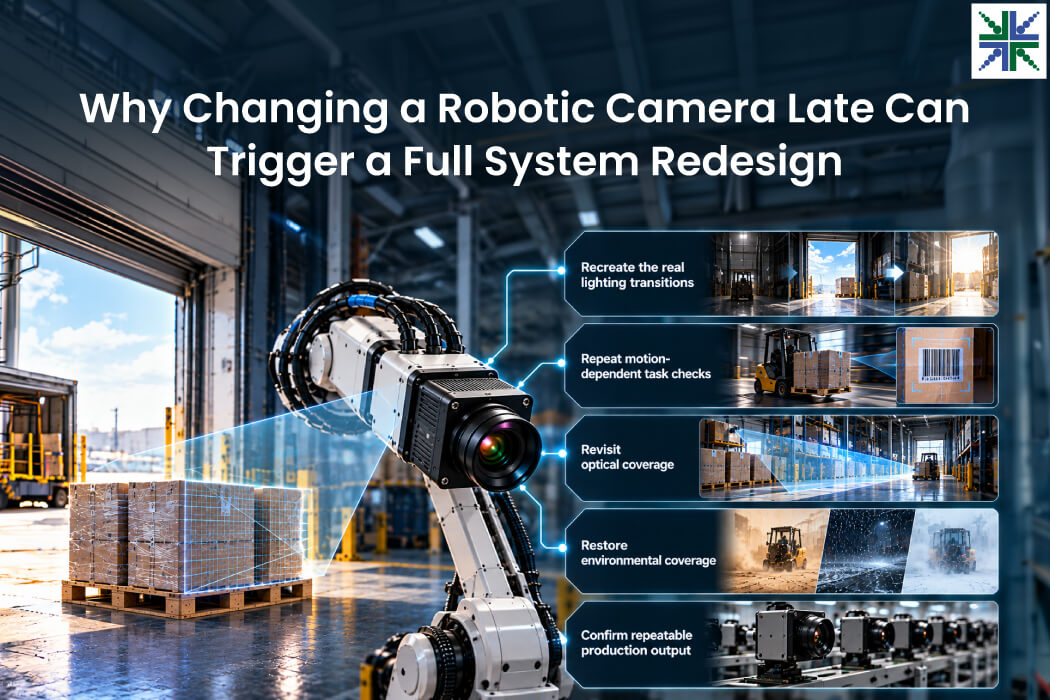
- Recreate the real lighting transitions: A robot may move from a dark warehouse aisle toward a bright dock door in under a second. It may also travel from a shed or tunnel into open sunlight, with bright sky beside deep shadow. The replacement camera must retain usable detail as exposure, HDR and white balance respond to those changes.
- Repeat motion-dependent task checks: Longer exposure can recover brightness in a poorly lit yard, though it also increases motion blur. Rolling-shutter capture can distort straight edges during movement and affect pose estimates. Barcode capture, fiducial docking and measurements taken when the robot moves must be reviewed with the shutter and exposure strategy used by the replacement.
- Revisit optical coverage: Wide optics keep VSLAM features visible and may reduce the camera count, yet distant objects occupy fewer pixels as the view widens. A module with a different lens configuration can change detection range even when a nearby target looks acceptable during bench testing. Working distance and field of view must be checked against the robot’s mounting position and hardest visual task.
- Restore environmental coverage: Indoor routes may introduce dust, wash-down, condensation and flicker, and outdoor operation adds rain, fog, mud, glare and wider temperature changes. IP67 addresses dust and temporary immersion, and IP69K pertains to high-pressure, high-temperature wash-down. Temperature testing must reflect the duty cycle, including transitions that can create condensation, and larger machines may also demand EMC testing near high-power motor drives.
- Confirm repeatable production output: Once the revised camera output is established, every shipped module must reproduce it. The hundredth machine has to give the software the same visual input as the validation unit.
e-con Systems Has Expertise In Robotic Camera Integration
Since 2003, e-con Systems has been designing, developing, and manufacturing embedded vision solutions – from custom OEM cameras to complete ODM platforms.
Explore e-con Systems’ camera portfolio using our Camera Selector.
Write to camerasolutions@e-consystems.com to discuss camera integration, customization, testing, or deployment with our experts.
Frequently Asked Questions
- Why can two robotic cameras with similar specifications produce different results?
The application receives processed ISP output rather than resolution and frame-rate figures alone. Differences in HDR, noise reduction, distortion correction, tone mapping and exposure can change the visual input supplied to software.
- Why may a replacement camera need AI retraining?
The original image configuration forms part of the AI training data. A different camera or ISP configuration can change the visual characteristics received by the model.
- How can camera replacement affect sensor fusion?
The camera’s intrinsic properties and its extrinsic relationship with other sensors feed the common coordinate frame. Replacement can require re-running calibration and timing checks to keep camera, LiDAR and radar readings aligned.
- Why can changing the camera interface affect the carrier board?
MIPI CSI-2, GMSL2, FPD-Link III and Ethernet follow different paths to the compute platform. Long-link cameras may need compatible serializers, deserializers, cabling and host-side inputs.
- Which tests should be revisited after a robotic camera replacement?
The revised camera should be checked under deployment lighting, motion, working-distance and environmental conditions. Production units must also reproduce the processed output established during validation.

Suresh Madhu is the product marketing manager with 16+ years of experience in embedded product design, technical architecture, SOM product design, camera solutions, and product development. He has played an integral part in helping many customers build their products by integrating the right vision technology into them.