



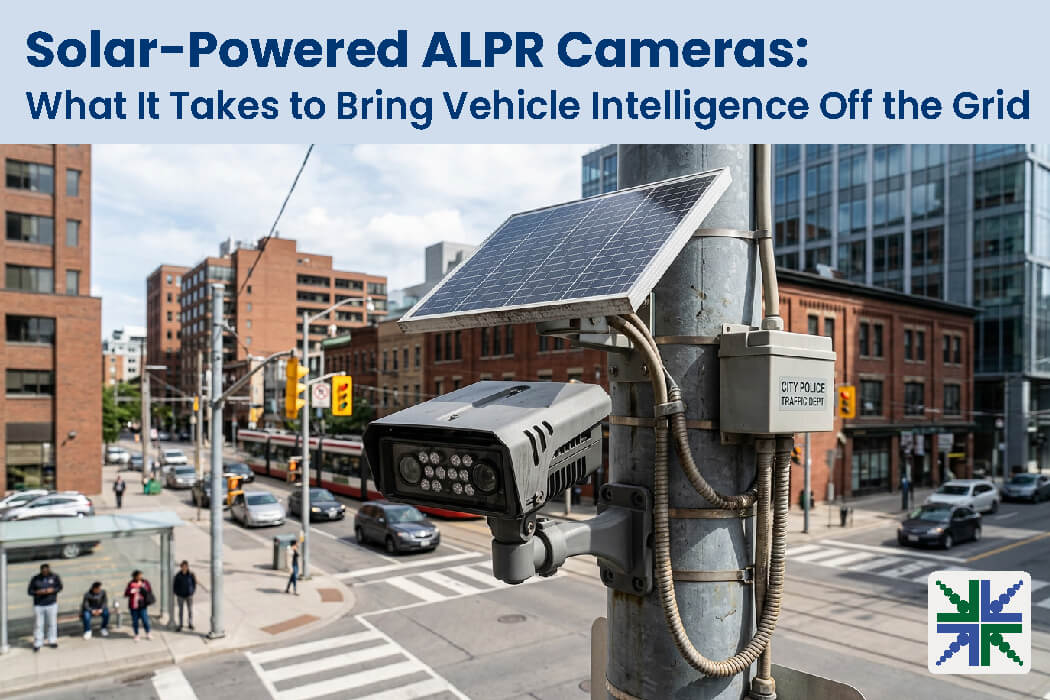
Automatic License Plate Recognition (ALPR) systems improve security, streamline access control, and enable traffic monitoring and vehicle identification. However, deploying ALPR cameras in locations without readily available power or network connectivity can be expensive, time-consuming, and operationally complex.
Solar-powered ALPR cameras offer a practical alternative by combining low-power imaging, edge AI processing, solar energy, and wireless connectivity. These systems enable vehicle identification and traffic intelligence in locations such as remote roads, construction sites, private communities, and isolated parking facilities without depending on grid power or wired network connections.
In this blog, you’ll learn how solar-powered ALPR works, its key technical requirements, and where it offers deployment flexibility.
Why Wired Infrastructure Limits ALPR Deployment
Installing conventional ALPR cameras in remote or infrastructure-constrained locations can present several challenges such as:
- High installation costs: Extending power and network cabling may require trenching, electrical work, and additional civil infrastructure, increasing deployment costs.
- Permitting delays: Installing cables across roads or public property may require permits and approvals, extending project timelines.
- Environmental disruption: Trenching and cable installation can disturb surrounding landscapes, particularly in environmentally sensitive locations.
- Limited flexibility: Relocating a wired camera may require additional infrastructure work if monitoring requirements change.
Solar-powered ALPR systems help overcome these infrastructure constraints, making vehicle monitoring more practical in locations where wired installations are difficult or costly.
How Solar-Powered ALPR Cameras Work
A typical solar-powered ALPR system combines a solar panel, battery and power-management system, ALPR camera, edge AI processor, and wireless connectivity. The solar panel generates electricity, while the battery stores energy to run operations during night-time and periods of limited sunlight.
When a vehicle enters the camera’s field of view, the system captures an image, identifies the license plate, and processes the information using onboard AI. After that, recognized plate information, vehicle metadata, and selected images can be transmitted to a central platform through cellular or other available wireless networks.
Solar-powered ALPR systems can reduce continuous network bandwidth requirements and communication-related energy consumption by processing vehicle information locally and transmitting only relevant data.
Key Design Requirements for Solar-Powered ALPR Cameras
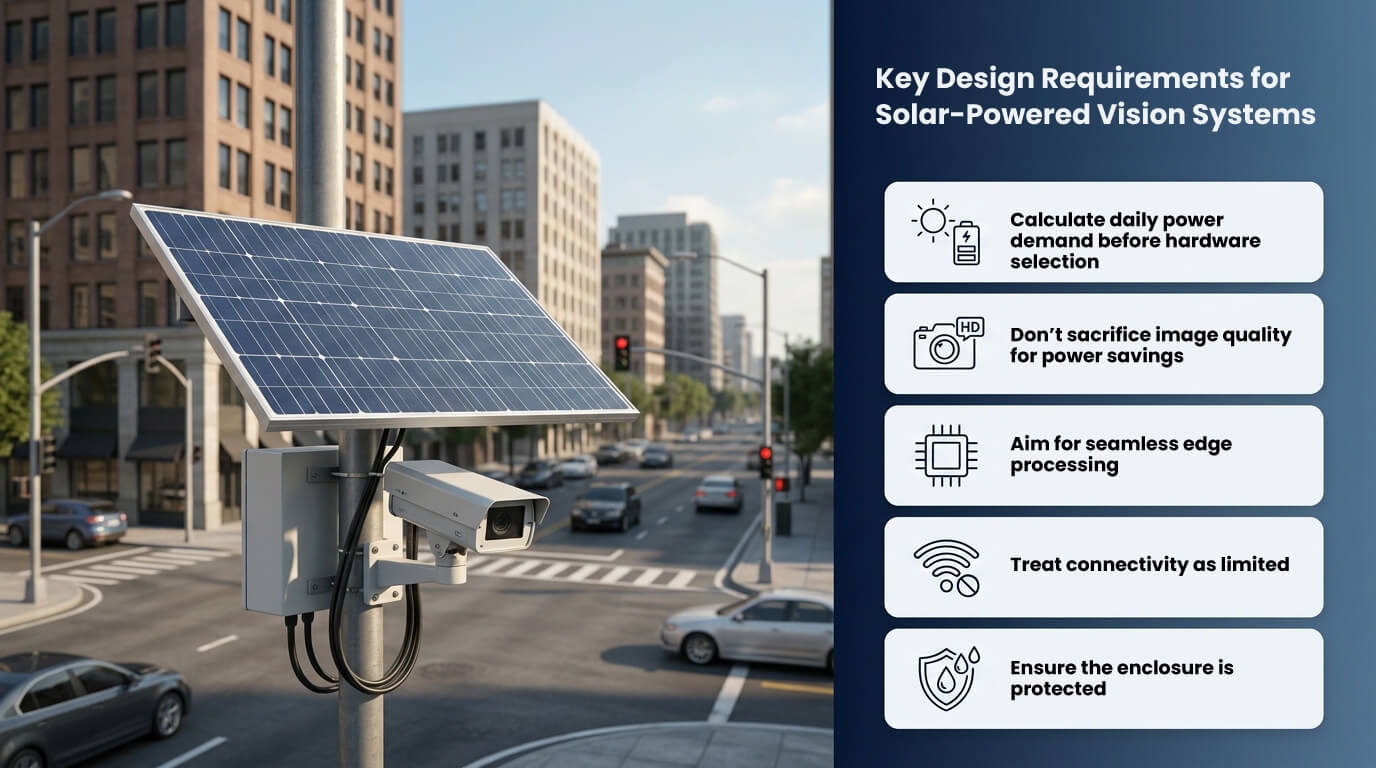
Power efficiency and energy management
Solar ALPR systems must operate within a limited power budget. The image sensor, edge processor, IR illumination, cellular modem, and supporting electronics all contribute to energy consumption.
Solar-panel and battery capacity should be selected based on local sunlight conditions, expected traffic activity, operating temperature, and required battery autonomy.
Event-driven capture and intelligent power management can further reduce average energy consumption by activating selected functions when vehicles are detected. However, the system must respond quickly enough to capture readable license plates, particularly when vehicles are moving at high speeds.
Reliable day/night ALPR imaging
Reliable license plate recognition depends on capturing clear plate images across varying lighting and environmental conditions. Depending on the application, ALPR systems may use monochrome/IR imaging, RGB and IR camera configurations, synchronized IR illumination, and optimized exposure control.
For moving vehicles, global-shutter imaging and short exposure times can help minimize motion blur. Sensor resolution, lens selection, plate pixel density, and mounting angles must also be considered to ensure sufficient image detail for reliable recognition.
Flexible installation and optical coverage
Solar availability can influence camera placement, but ALPR performance still depends on appropriate viewing angles, capture distance, and field of view. Selecting suitable optics, sensor resolution, and, where required, motorized zoom can help optimize plate capture without compromising image readability.
Ruggedization for outdoor environments
Outdoor ALPR systems must withstand rain, dust, temperature variations, and other environmental challenges. Hence, weather-sealed enclosures, suitable operating-temperature ranges, and corrosion-resistant materials support reliable long-term operation, including in demanding outdoor and coastal environments.
Edge AI vs. Cloud Processing in Solar-Powered ALPR
For solar-powered deployments, edge AI processing can offer important advantages over architectures that depend on continuously transmitting video to the cloud. By processing vehicle images locally, edge AI enables:
- Reduced bandwidth requirements: Recognized plate information, vehicle metadata, and selected images can be transmitted instead of continuous high-resolution video streams.
- Improved power efficiency: Minimizing continuous cellular transmission can lower communication-related energy consumption.
- Low-latency processing: Vehicle detection and plate recognition can take place near the camera, ensuring faster local decisions and alerts.
However, edge processing does not eliminate the need for cloud-based platforms. Recognized plate data, images, and events can still be transmitted to a central system for storage, search, analytics, watchlist management, and monitoring across multiple camera locations.
Where Solar-Powered ALPR Makes Sense
Private communities
Solar-powered ALPR cameras can monitor vehicle entrances and exits, capture license plate information, and drive security operations without extensive cabling work.
Rural roads and highways
Remote roads may lack convenient power and network infrastructure. Solar-powered ALPR can support vehicle identification, traffic studies, and monitoring applications. When integrated with appropriate speed-measurement systems, it can also empower speed-enforcement applications.
Construction sites
Temporary construction sites may require vehicle monitoring without permanent infrastructure. Solar-powered ALPR can help identify vehicles entering or leaving a site and help with investigations into unauthorized access or theft.
Parking facilities
Solar-powered ALPR can provide vehicle identification at isolated parking facilities where extending wired infrastructure may be impractical.
Temporary events
Festivals, fairs, and other short-term events may require temporary vehicle monitoring. Solar-powered ALPR systems can provide a flexible alternative to permanent wired installations, subject to suitable power and connectivity conditions.
When Solar-Powered ALPR May Not Be Suitable
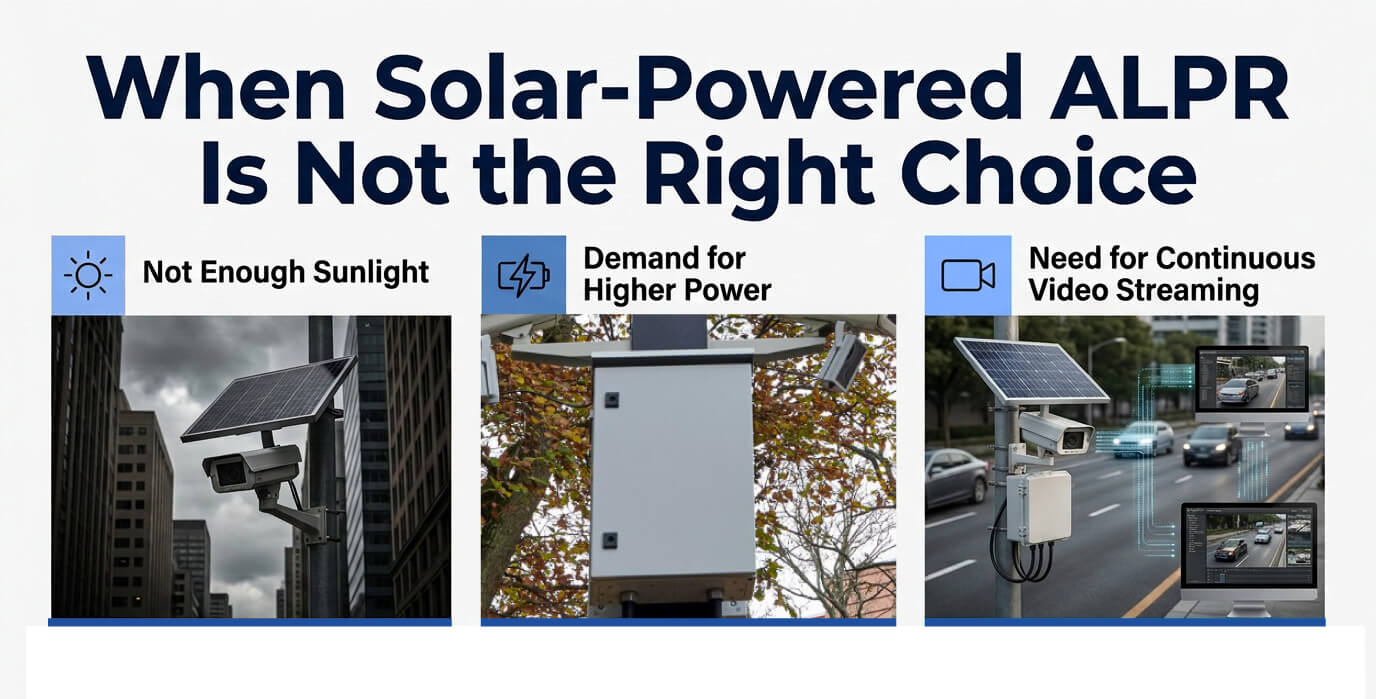
Insufficient sunlight or unsuitable installation locations
Sites with permanent shade, limited solar exposure, or underground installations may not support reliable solar charging. Urban locations surrounded by tall buildings can also present challenges for solar-panel placement.
Limited network connectivity
Remote locations may have sufficient sunlight but unreliable cellular connectivity. Depending on the application, local storage and store-and-forward mechanisms can retain events until connectivity is restored, while alternative communication options may also be considered. However, applications requiring immediate remote alerts need reliable communication.
Continuous high-resolution video requirements
Applications requiring continuous high-definition video recording or streaming may have higher power, storage, and bandwidth requirements, making wired power and connectivity more practical.
Mission-critical uptime requirements
Installations with stringent availability requirements may need redundant power and communication systems rather than relying solely on solar energy and cellular connectivity.
Why e-con Systems for ALPR Camera Solutions?
Since 2003, e-con Systems has been designing, developing, and manufacturing embedded vision solutions, ranging from OEM cameras to complete ODM platforms. We provide customized embedded vision solutions for traffic management, security, and surveillance applications.
Our expertise in sensor selection, global-shutter imaging, IR illumination, optics, and edge AI camera integration helps address challenging ALPR requirements, such as high-speed vehicle capture, variable lighting, and outdoor deployments.
For solar-powered and off-grid ALPR applications, we can help evaluate camera and imaging configurations based on power consumption, image quality, processing requirements, and deployment constraints. We also offer customization options for camera form factors, lens mounts, zoom requirements, and rugged enclosures based on application needs.
Explore our TrafficSenz ALPR camera solution or use our Camera Selector to identify suitable imaging solutions.
Write to camerasolutions@e-consystems.com if you want to talk to one of our vision experts regarding camera selection, integration, or customization.
Frequently Asked Questions
How does a solar-powered ALPR camera work?
A solar-powered ALPR system uses a solar panel, battery, power-management electronics, and an ALPR camera with onboard edge AI processing. It captures vehicle images, recognizes license plates locally, and transmits selected data through wireless connectivity without requiring grid power at the installation site.
Why choose solar-powered ALPR instead of wired cameras?
Solar-powered ALPR can reduce the need for trenching and new power or network cabling. It is particularly useful for temporary, remote, or infrastructure-constrained installations where conventional wiring may be expensive or impractical.
What are the main technical challenges in solar-powered ALPR?
Key challenges include managing power consumption, maintaining reliable plate capture during day and night, handling moving vehicles, selecting suitable optics, and ensuring reliable operation in outdoor environments.
Why is edge AI important for solar-powered ALPR?
Edge AI enables local vehicle and license plate recognition, reducing the need to continuously transmit video. This can lower bandwidth requirements, reduce communication-related energy consumption, and support low-latency processing.
Where can solar-powered ALPR cameras be deployed?
Common applications include private-community entrances, remote roads, construction sites, isolated parking facilities, and temporary events where suitable sunlight, mounting conditions, and connectivity are available.
When is solar-powered ALPR not recommended?
Solar-powered ALPR may be less suitable for locations with insufficient sunlight, unreliable network connectivity, continuous high-resolution video requirements, or mission-critical uptime requirements without adequate redundancy. Alternative power or communication arrangements may be needed for these applications.

Dilip Kumar is a computer vision solutions architect having more than 8 years of experience in camera solutions development & edge computing. He has spearheaded research & development of computer vision & AI products for the currently nascent edge AI industry. He has been at the forefront of building multiple vision based products using embedded SoCs for industrial use cases such as Autonomous Mobile Robots, AI based video analytics systems, Drone based inspection & surveillance systems.