



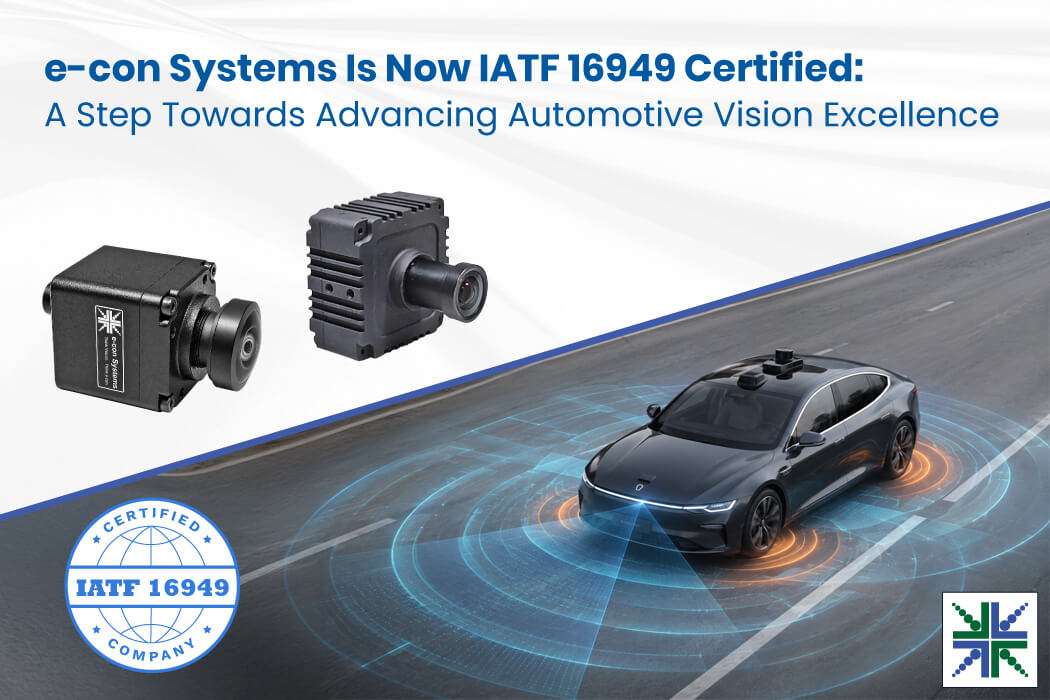
e-con Systems has achieved IATF 16949 certification, with its scope covering design and manufacturing of embedded vision systems, marking a new milestone in our automotive vision journey. The achievement further reflects our continued commitment to automotive quality management under the IATF 16949:2016 standard.
Bureau Veritas Certification awarded the IATF 16949 certification after auditing e-con Systems’ Quality Management System and finding it to meet the requirements of IATF 16949 – First Edition and applicable customer-specific requirements.
In this blog, you’ll get a quick look at what this milestone means for our automotive quality processes and the camera areas covered within the IATF 16949 scope. Also, get to know how e-con Systems is extending this focus from quality to safety through the active development of ISO 26262 functional-safety-compliant cameras.
What IATF 16949 Means in Automotive Manufacturing
Automotive development places strong demands on quality management because every stage, from design through manufacturing, has to work within clearly defined processes and customer expectations.
IATF 16949:2016 is an Automotive Quality Management System standard for organizations within the automotive supply chain. It places structured controls around product and manufacturing risks, customer requirements, process performance, and supplier quality.
Within automotive programs, the standard places greater emphasis on preventing failures at their source rather than relying primarily on detection after an issue occurs. It also strengthens the link between product design decisions and manufacturing process requirements.
At e-con Systems, the standard also strengthens quality assurance throughout the supply chain by placing greater focus on supplier quality management within automotive programs.
What Are the Key Quality Practices Under IATF 16949?
- Risk-based thinking throughout the product lifecycle: Potential product and manufacturing-process risks are identified and addressed from design through product realization, with greater emphasis on preventing errors at their source.
- Special characteristics, product safety, and validation: Product and process characteristics that can influence performance, reliability, or safety are identified, evaluated, and controlled. Product and process validation also receives stronger focus around product safety, regulatory compliance, and reliability.
- Measurement and statistical process studies: Measurement systems are evaluated so inspection results remain reliable for decision-making. Statistical methods are used to understand process variation and process capability.
- Customer-specific requirements: Applicable customer-specific requirements are reviewed, evaluated, and implemented within the relevant processes.
- Design-to-manufacturing transition: Product design decisions are linked with manufacturing process requirements, including manufacturability considerations. Structured approaches such as APQP and PPAP support the transition into manufacturing.
e-con Systems’ IATF 16949-Certified Automotive Cameras
Four automotive camera areas
The IATF 16949 scope covers four automotive camera areas within e-con Systems’ embedded vision portfolio:
- Forward-facing cameras
- Rear view cameras
- Surround view cameras
- Driver monitoring cameras
They each have a different function in the vehicle, yet all require disciplined design and manufacturing practices as part of automotive programs.
The front cameras meet the need for forward-facing vision, whereas the rear cameras offer images from the back of the vehicle. Surround-view systems combine several camera inputs in order to give a broader view of the area around the vehicle. Driver monitoring cameras take images which are directed at the driver for use by in-cabin monitoring systems.
Extending automotive quality into functional safety
IATF 16949 strengthens the quality processes that connect product development with manufacturing and production. In parallel, e-con Systems is actively developing ISO 26262 functional-safety-compliant cameras for automotive and mobility applications.
The two efforts address different parts of the automotive camera lifecycle. The ISO 26262 work brings functional safety into camera development. The IATF 16949-certified Quality Management System applies automotive quality controls from design through production.
e-con Systems Offers High-Performance Automotive Vision Solutions
Since 2003, e-con Systems has been designing, developing, and manufacturing embedded vision solutions, from custom OEM cameras to complete ODM platforms. We offer automotive cameras with features like HDR up to 140 dB, LED flicker mitigation, and multi-camera synchronization. Our cameras also seamlessly operate in harsh operating conditions, supporting requirements such as RoHS 3, REACH, AEC-Q100 Grade 2, and IP69K.
e-con Systems’ cameras are also validated on NVIDIA Jetson edge-AI platforms, enabling rapid development – from prototyping through production.
Explore all our automotive cameras
Visit our Camera Selector Page to zero in on the perfect vision solution for your application.
If you’d rather talk to one of our vision experts to discuss your specific requirements, please write to camerasolutions@e-consystems.com.
FAQs
- How do IATF 16949 and ISO 26262 contribute to e-con Systems’ automotive camera programs?
IATF 16949 strengthens the quality processes applied from design through production. In parallel, e-con Systems is actively developing ISO 26262 functional-safety-compliant cameras for automotive and mobility applications.
- What does e-con Systems’ IATF 16949 scope cover?
The scope covers design and manufacturing of embedded vision systems.
- Which e-con Systems automotive cameras come under this scope?
The scope includes front, rear, surround-view, and driver monitoring camera areas.
- Which quality practices does IATF 16949 strengthen within e-con Systems?
It places greater focus on risk prevention, product and process validation, measurement-system evaluation, statistical process studies, customer-specific requirements, supplier quality management, and structured design-to-manufacturing planning.
- What features do e-con Systems’ automotive cameras offer?
They include features such as HDR up to 140 dB, LED flicker mitigation, and multi-camera synchronization, with support for requirements including RoHS 3, REACH, AEC-Q100 Grade 2, and IP69K.

Prabu is the Chief Technology Officer and Head of Camera Products at e-con Systems, and comes with a rich experience of more than 15 years in the embedded vision space. He brings to the table a deep knowledge in USB cameras, embedded vision cameras, vision algorithms and FPGAs. He has built 50+ camera solutions spanning various domains such as medical, industrial, agriculture, retail, biometrics, and more. He also comes with expertise in device driver development and BSP development. Currently, Prabu’s focus is to build smart camera solutions that power new age AI based applications.