



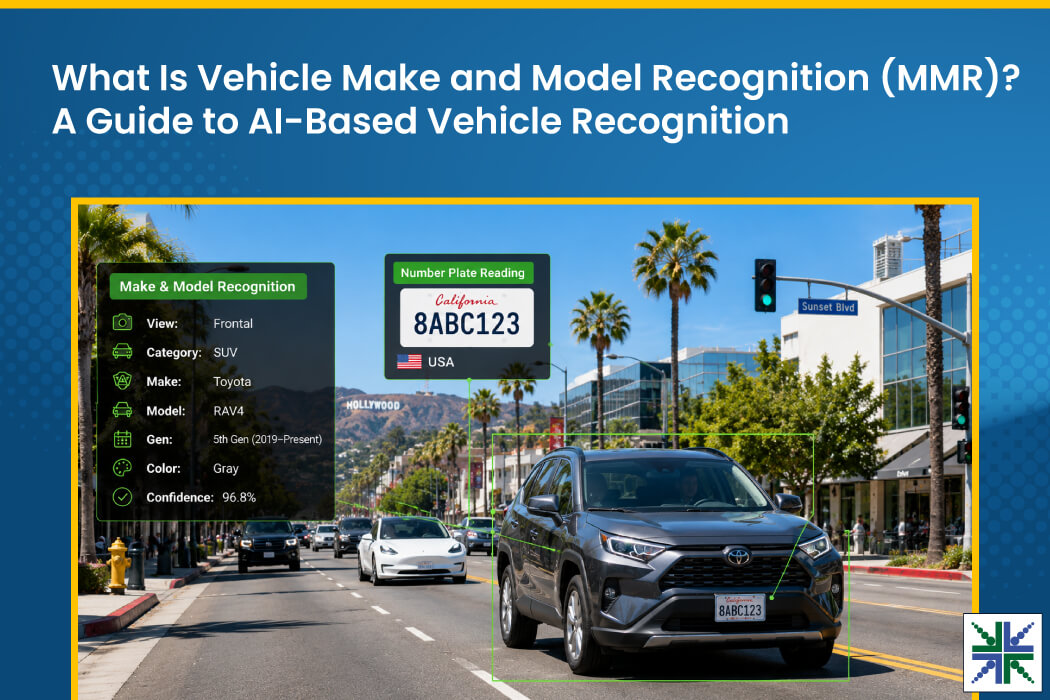
Modern roads generate more vehicle data than ever before. Traffic management systems, security checkpoints, parking facilities, tolling infrastructure, and law enforcement agencies all depend on fast, accurate vehicle identification. While Automatic Number Plate Recognition (ANPR) has become critical for vehicle identification, a license plate alone doesn’t always tell the complete story. Plates can be cloned, obscured, or misread, and eyewitnesses often remember a vehicle’s color or model rather than its registration number.
However, that is changing. A new generation of AI-powered cameras can now analyze the visual characteristics of a vehicle in real time. They help identify the vehicle’s brand, model, generation, and even color within milliseconds of it entering the frame!
This is known as Vehicle Make and Model Recognition (MMR).
This blog explores what MMR is, how it works alongside ANPR camera technology, why it matters, and where it is already delivering real-world value.
What Is Vehicle Make and Model Recognition (MMR)?
MMR is an AI-powered computer vision technology that automatically identifies a vehicle’s manufacturer (make), model, generation, vehicle category (such as sedan, SUV, pickup truck, bus, motorcycle, or heavy truck), and color using images captured by ANPR or CCTV cameras.
Unlike ANPR, which identifies a vehicle through its registration plate, MMR identifies the vehicle through its visual characteristics such as its make, model, generation, body type, and color.
This distinction matters significantly in real-world deployments. For instance, witnesses at an incident rarely memorize plate numbers, but they almost always remember a “red SUV” or a “black pickup truck.” An MMR-led system can use that description as a search filter and surface a match in seconds.
Modern MMR platforms can recognize hundreds of vehicle makes and thousands of individual models, covering passenger cars, motorcycles, buses, vans, and heavy commercial vehicles. Recognition coverage depends on the training dataset and regional vehicle database.
How MMR Works Alongside ANPR Cameras
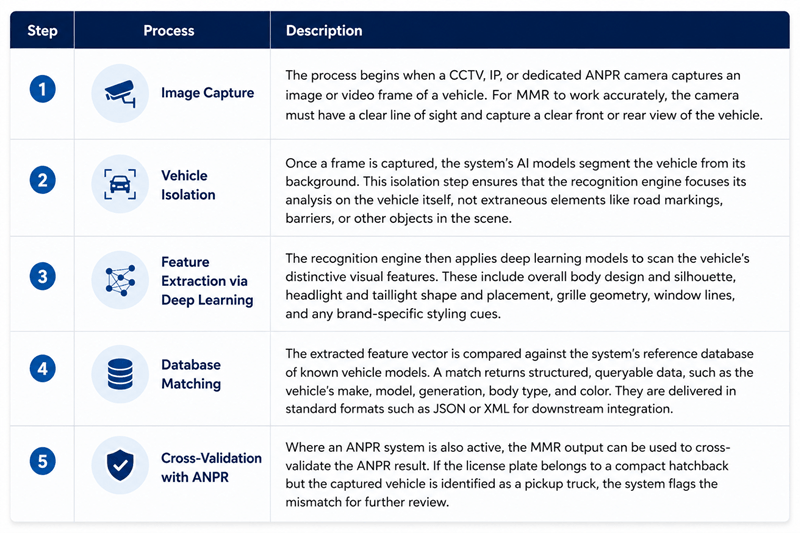
The system isolates the vehicle from the background, extracts key visual features using deep learning, and compares them against a reference database of known vehicle models. The result is structured data that can be used to verify or complement an ANPR read.
Why Advanced Vision-Powered MMR Is Critical
Verifying vehicle identity beyond the license plate
A license plate tells you how a vehicle is registered. MMR tells you what the vehicle actually is. Plates can be swapped, cloned, obscured, or misread under difficult lighting or weather conditions. MMR provides a physical verification layer that ANPR alone cannot offer.
Generating deeper vehicle insights
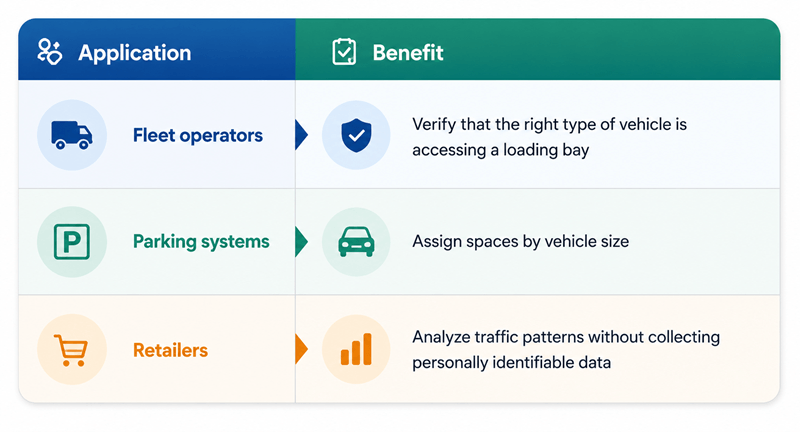
Raw plate data is, by itself, relatively thin. With MMR, every vehicle read becomes a structured profile:
 Accelerating incident resolution
Operators reviewing hours of footage face a needle-in-a-haystack problem when searching by plate alone. With MMR metadata stored against every vehicle read captured across the ANPR camera network, a search can be narrowed within seconds by filtering on color, body type, make, or model.
Supporting smart city and sustainability goals
MMR provides transportation agencies and smart city operators with richer vehicle intelligence for traffic analytics, vehicle classification, and sustainability initiatives.
Driving privacy-aware data collection
Vehicle make, model, and color are generally less directly identifying than license plate numbers, although applicable privacy regulations vary by jurisdiction. This makes MMR valuable for traffic analytics where minimizing personally identifiable information is important.
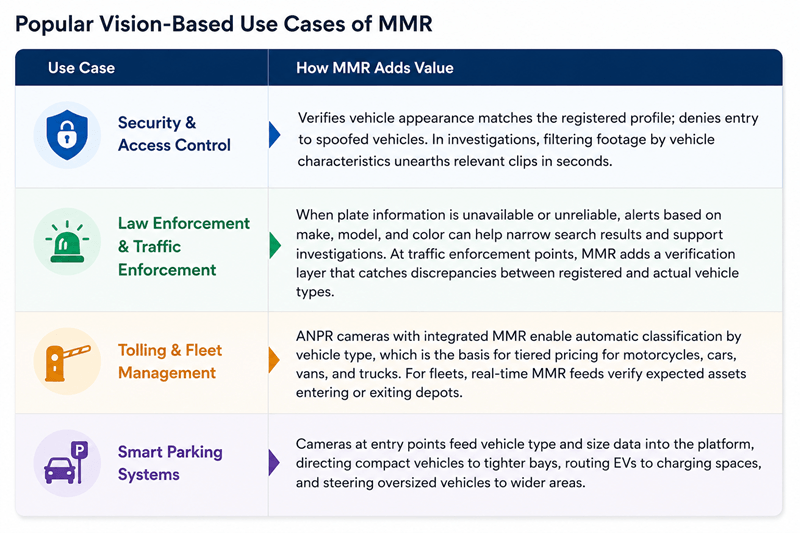
Popular Vision-Based Use Cases of MMR
Detailed Comparison: ANPR vs. MMR
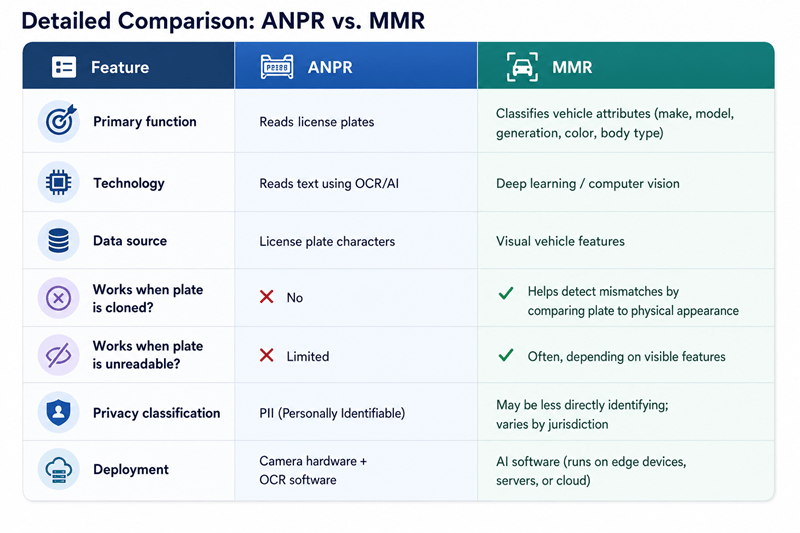 Conclusion
The reality is that ANPR is no longer sufficient on its own. As roads become smarter and data demands grow, the ability to identify not just who a vehicle belongs to but what it actually is has become essential. Vehicle Make and Model Recognition closes the gap between a vehicle’s registered identity and its physical appearance. When paired with ANPR, MMR creates a powerful validation layer that catches spoofed plates, automates classification, and transforms raw video feeds into actionable intelligence.
For transportation authorities, law enforcement agencies, parking operators, and smart city planners, combining ANPR with MMR enables deeper vehicle insights, stronger verification, and more informed operational decisions.
e-con Systems’ ANPR Cameras for Vision-Based MMR
e-con Systems® designs, develops, and manufactures embedded vision solutions from custom OEM cameras to complete ODM platforms. We understand that the accuracy of any MMR solution depends heavily on image quality. High-speed vehicles, low-light conditions, glare, and motion blur can significantly affect recognition performance. That’s why e-con Systems provides OEM/ODM ANPR camera solutions that deliver the image quality required for reliable AI-based vehicle make and model recognition.
Whether you need sharp front or rear vehicle capture at high traffic speeds, low-light infrared performance, or a compact form factor for embedded deployments, our cameras are built to meet the precise imaging demands that MMR algorithms depend on.
Explore our Camera Selector Page to find the best-fit camera for your embedded vision systems.
Please write to camerasolutions@e-consystems.com if you need to talk to a vision solution expert.
FAQs
What is the difference between ANPR and MMR?
ANPR (Automatic Number Plate Recognition) identifies a vehicle by reading its license plate. MMR (Make & Model Recognition) goes a step further by analyzing the vehicle’s visual appearance through the camera feed to identify its manufacturer, model, generation, and color.
Does MMR require AI?
Yes. Modern MMR systems rely on deep learning and computer vision algorithms trained on large datasets of vehicle images. These AI models analyze visual characteristics such as headlights, grille shape, body profile, and other distinctive features to identify a vehicle’s make, model, generation, and color.
What kind of camera do you need for MMR to work accurately?
Accurate MMR depends on clear, high-quality images. Cameras should provide sufficient resolution, fast shutter speeds to minimize motion blur, and reliable low-light performance. Dedicated ANPR cameras are designed to meet these imaging requirements.
Can MMR be used without a license plate recognition system?
Yes. MMR can function as a standalone vehicle classification tool. However, pairing MMR with ANPR unlocks its full value, enabling cross-validation between the plate read and the vehicle’s physical profile to catch spoofed or cloned plates. MMR can operate independently, but it cannot uniquely identify a specific vehicle in the way a license plate can. Combining MMR with ANPR provides both unique identification and visual verification.
Which industries benefit the most from vision-based MMR?
- Security and access control teams use it to speed up incident investigations
- Law enforcement applies it to stolen vehicle recovery and traffic enforcement
- Tolling operators use it for automatic vehicle classification and tiered pricing
- Smart city planners rely on it for low-emission zone enforcement
- Retailers and hospitality venues use anonymized MMR feeds for customer analytics
Why is e-con Systems a reliable choice for ANPR cameras in MMR deployments?
e-con Systems brings over two decades of OEM camera design and manufacturing experience to ANPR and vision-based vehicle recognition applications. Our cameras meet the precise image quality demands that MMR algorithms depend on, including high-speed capture, low-light infrared performance, and the resolution needed to distinguish vehicle makes and models at the edge.
e-con Systems also offers deep customization capabilities, covering lens configurations, form factor changes, zoom optimizations, and enclosures.

Dilip Kumar is a computer vision solutions architect having more than 8 years of experience in camera solutions development & edge computing. He has spearheaded research & development of computer vision & AI products for the currently nascent edge AI industry. He has been at the forefront of building multiple vision based products using embedded SoCs for industrial use cases such as Autonomous Mobile Robots, AI based video analytics systems, Drone based inspection & surveillance systems.