



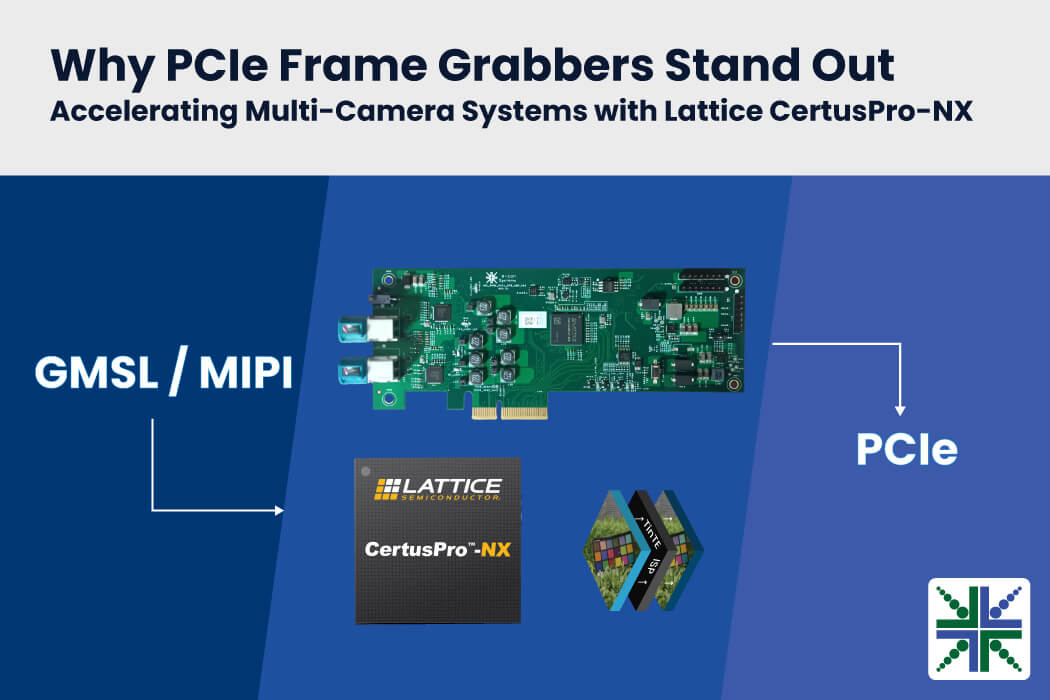
Simply put, a frame grabber is the bridge between a camera (or a group of cameras) and a computer system. It captures image streams, timestamps/synchronizes them (when needed), and delivers frames to memory in a format the application can consume.
The right frame grabber is typically a function of three considerations:
- Bandwidth (resolution × frame rate × bit depth × number of cameras)
- Latency and determinism (speed and predictability of delivery)
- System architecture (PC/x86 vs. embedded, CPU/GPU pipeline, OS/driver requirements)
What Are the Interface Technologies of Frame Grabbers?
Frame grabbers support a variety of camera interfaces, each optimized for different use cases and deployment environments. Let’s understand their strengths and limitations in relation to scalable and reliable vision systems.
USB-based (USB3/USB3.2/UVC-style)
USB-based frame grabbers are mostly preferred for plug-and-play and rapid prototyping. However, USB is host-scheduled and shared, which complicates deterministic behavior under load when used with multiple cameras, where CPU/GPU are heavily loaded.
Ethernet-based (GigE Vision/2.5/5/10GigE)
They are excellent for long cables, distributed systems, and standardized networking infrastructure. You get flexibility, but latency/jitter depends on network topology, traffic, NIC settings, packetization, and OS networking stack behavior.
Dedicated high-speed vision links (e.g., CoaXPress, Camera Link, etc.)
These are strong contenders for industrial vision with high throughput and robust cabling. However, they often require specialized acquisition hardware and are great when the camera ecosystem is built around those standards.
PCIe-based frame grabbers
PCIe frame grabbers exist inside the host system and connect close to the CPU/memory complex. They are advantageous if you care about high aggregate bandwidth, lower and more predictable latency, and tight host integration (DMA straight into host memory, interrupts/events, and efficient multi-camera scaling).
Scaling Frame Grabbers for Multi-Camera Systems
A single camera at moderate resolution/frame rate is usually straightforward. The problems show up when you scale to 2, 4, 8+ cameras, especially if they’re a mix of sensors, formats, and frame timing. At that point, the frame grabber becomes a real-time camera data + synchronization + memory scheduling system.
The following points show the challenges frame grabbers should handle:
- Processing overhead: Cameras do not always provide a smooth stream. You receive bursts at line/frame boundaries, in packetized transfers, or because of host scheduling.
- Stream-level overhead: As the number of cameras increases, so does the per-stream overhead, including additional descriptors, interrupts (such as MSI-X vectors), context switches, and metadata processing.
- Host memory pressure: Sustained multi-stream DMA competes with CPU, GPU, NIC, and storage bandwidth.
To meet these requirements, the frame grabber is designed with high-throughput video capture, deterministic FPGA control logic, and low-overhead host DMA integration.
Let’s examine the internal architecture of a PCIe-based frame grabber.
A Deep Dive into the Architecture of PCIe Frame Grabbers
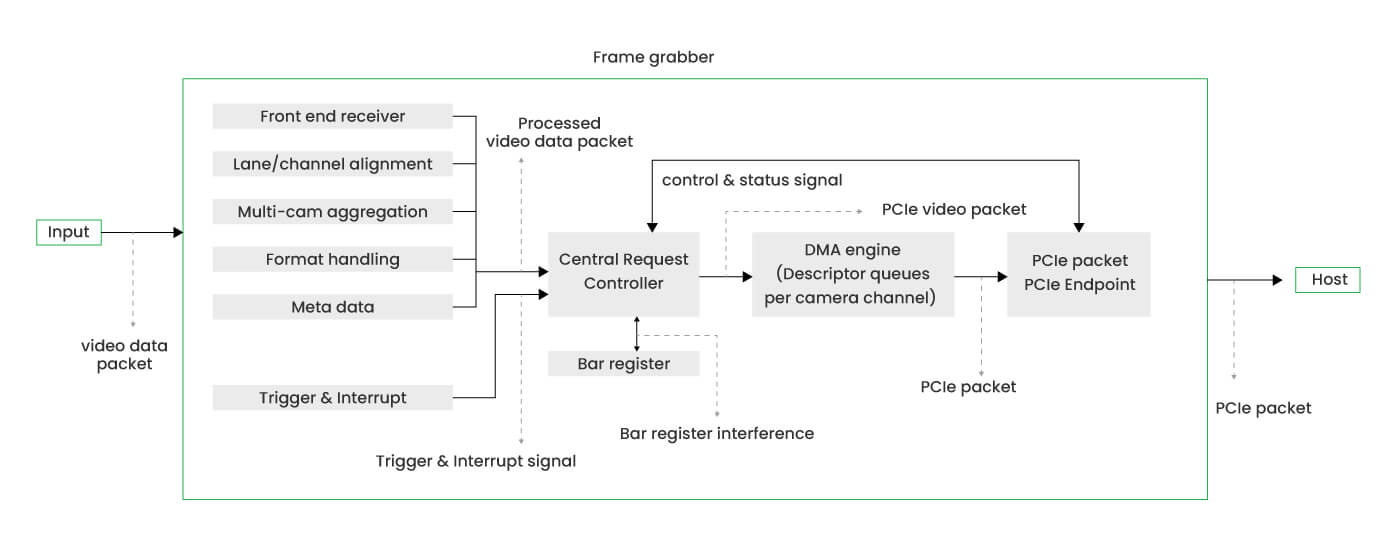
A PCIe frame grabber is a combination of high-speed video ingress, real-time processing/aggregation, and a PCIe endpoint with a DMA engine.
The following diagram illustrates the architecture of a PCIe-based frame grabber.
 1) Video input Interfaces
Depending on the camera ecosystem, the “front end” can be:
- MIPI
- SUB-LVDS
- LVDS
- SLVS
- HDMI
- GMSL
2) Data path in FPGA
Once pixels enter the grabber, the FPGA pipeline typically handles:
- Lane/channel alignment (per-link framing, deskew, line/frame markers)
- Aggregation (multiple cameras → a unified memory/buffer model)
- Format handling (RAW, YUV, RGB; packing/unpacking; stride handling)
- Metadata insertion (timestamps, frame IDs, exposure/gain state, CRC/error flags)
- Synchronization (cross-camera trigger distribution, timestamp correlation, PTP-like timebases when applicable)
As part of its imaging pipeline expertise, e-con Systems also offers optional integration of the proprietary TintE™ ISP IP core within the FPGA.
TintE ISP supports:
- High-quality debayering
- Brightness, saturation and contrast control
- Auto white balance and auto exposure
- Denoising
- Color correction and gamma correction
- Sharpness block
The TintE ISP is available as an optional customization based on specific customer requirements. By default, the FPGA data pipeline operates without integrated ISP functionality.
3) PCIe endpoint + register model (control plane)
A robust control plane for the PCIe-based frame grabbers usually includes:
- BAR-mapped registers for configuration (camera enables, ROI, format, triggers)
- Status and health telemetry (link lock, errors, temperature, bandwidth counters)
- Doorbells/queues for buffer submission and completion signaling
Modern designs often expose a queue-based interface so the driver can enqueue buffers without heavy per-frame register chatter.
4) DMA engine (data plane)
This is where PCIe grabbers win. Typical building blocks include:
- DMA-based data transfer (work with non-contiguous host buffers)
- Descriptor queues (ring buffers for high throughput)
- Interrupt moderation (balance latency vs. CPU overhead)
- Per-camera channels (burst traffic from one camera does not stall or impact other streams)
- Backpressure and overflow strategy (drop policy or stall policy)
e-con Systems specifically ensures that the PCIe driver logic on the FPGA/card side handles the descriptor queue, burst engine, interrupt controller, and DMA address counters. These are exactly the modules you expect in a high-performance grabber.
5) Host driver + user-space API
On the host, you usually provide:
- A kernel driver that:
- Allocates/pins DMA buffers
- Manages DMA descriptors and completion interrupts
- Exposes a user-space API (IOCTL, mmap, or a library)
- A user-space SDK that:
- Provides a camera abstraction (start/stop/controls)
- Offers a clean frame callback/polling interface
- Integrates with OpenCV/GStreamer/DirectShow/Media Foundation, etc.
The goal is “fast path” capture into memory plus “easy path” integration for applications.
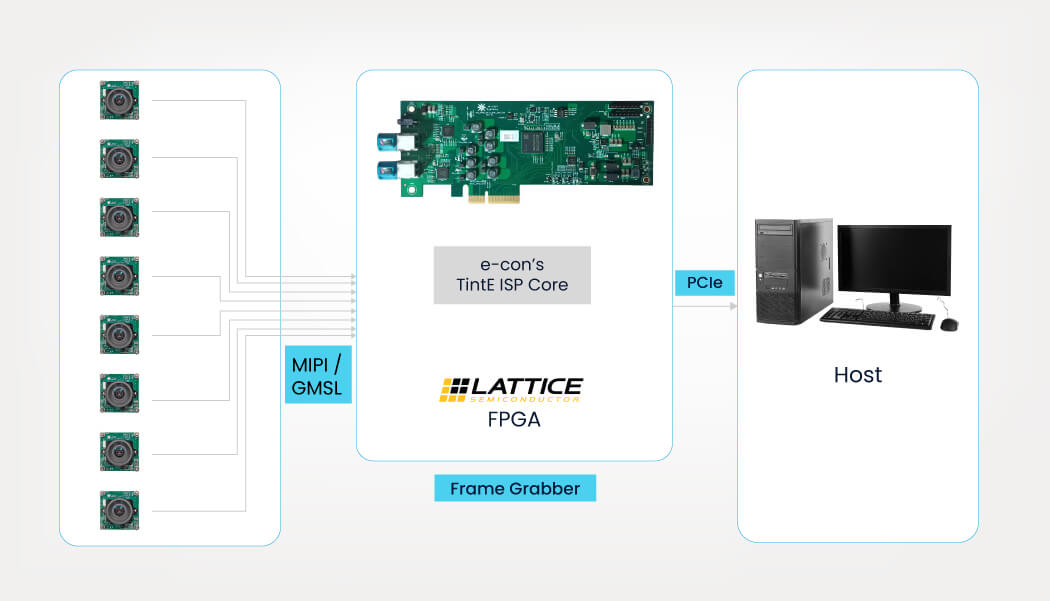
e-con Systems’ PCIe frame grabber card is a multi-camera acquisition solution based on the GMSL video input.
The conceptual diagram of the frame grabber, which receives inputs from multiple MIPI cameras/GMSL cameras and transfers processed data to a host PC via PCIe, is shown in the figure below.
Why Lattice CertusPro™-NX for PCIe Frame Grabbers?
A PCIe frame grabber FPGA must balance four competing needs:
- High-speed I/O (camera ingress + PCIe)
- Enough on-chip memory for buffering/queueing
- Deterministic real-time behavior
- Low power and compact form factor (practical board design)
The Lattice CertusPro-NX addresses each of the needs.
PCIe Gen3 x4 in hard IP
Lattice CertusPro-NX includes PCIe Gen3 x4 support in hard IP. For frame grabbers, Gen3 x4 is often an ideal balance. This includes plenty of throughput for multiple camera streams, while keeping BOM, routing complexity, and power manageable.
High-speed SerDes for camera aggregation
Lattice CertusPro-NX supports up to 10G SerDes capability and is ideal for applications needing high-speed serial connectivity. This is valuable when your “camera side” is serializer-based or when you need flexible high-speed links beyond PCIe.
Memory and buffering options (including LPDDR4 support)
Frame grabbers benefit from buffering to handle burstiness, arbitration between cameras, and host-side variability. CertusPro-NX offers more on-chip memory and LPDDR4 support than other competing FPGAs in its class.
Reliability and always-on behavior
In industrial/embedded deployments, long uptimes matter. Lattice CertusPro-NX devices offer 100x lower soft error rate than other FPGAs in its class due to their 28 nm FD-SOI process technology and high reliability focus.
Board-level practicality
Lattice Nexus™ based FPGA families offer lower power and small form factors for compact designs, which help PCIe cards meet thermal and mechanical constraints (especially in small industrial PCs).
Clear fit for video bridging and PCIe capture use cases
Lattice offers a CertusPro-NX PCIe Bridge board that supports high-performance video bridging designs with flexible I/O expansion, aligned with “frame grabber + video I/O” architecture and development.
How e-con Systems Enables End-to-End Multi-Camera Vision Systems
Deploying a multi-camera vision system means solving problems across the entire signal chain. e-con Systems supports the complete pipeline:
1) Full-stack camera integration expertise
e-con Systems helps you bridge the full chain:
Sensor → SerDes/Link → Frame Grabber → Host Memory → ISP/Compute → App
It matters because the hardest bugs show up in the seams: intermittent link errors, lane alignment corner cases, sync drift between cameras, and integration friction between driver and application.
e-con Systems offers a range of imaging pipeline solution support, starting from camera hardware, ISP, drivers, software stock, and application examples.
Read: How FPGA-Based Frame Grabbers Are Powering Next-Gen Multi-Camera Systems
2) Multi-camera scaling
e-con Systems’ frame grabber board supports up to 8 camera interfaces via the GMSL link and delivers high-performance image acquisition, with a total system throughput of approximately 22 Gbps. It supports a wide range of frame rates and resolutions, enabling configurations of up to eight cameras at 4K resolution running at 20 fps.
The table below outlines the validated resolution options currently available as turnkey solutions:
| MODE NAME | RESOLUTION | NUMBER OF CAMERAS | FPS | BANDWIDTH ACHIEVED |
| 4K | 3840×2160 | 8 | 20 | 21.3 Gbps |
| 1080p | 1920×1080 | 8 | 60 | 15.9 Gbps |
| 720p | 1280×720 | 8 | 60 | 7.07 Gbps |
3) Image quality tuning and support
Real deployments require consistent image quality across lighting, lens variations, temperature drift, and scene dynamics. Practical tuning support includes:
- Color pipeline tuning (AWB, CCM, gamma, tone mapping)
- RAW workflow support when customers want their own ISP pipeline
- Noise reduction vs. detail preservation trade-offs
4) Driver support and platform coverage
Driver maturity is often the #1 deciding factor in real deployments. Strong driver support includes:
- Linux support: For Linux, e-con Systems provides V4L2-based PCI drivers, which make App development seamless, and they can access the PCI camera like a USB Camera or MIPI Camera
- Validation on platforms: e-con Systems provides platform support across leading architectures, including ARM-based platforms (NVIDIA) and x86-based platforms (Intel and AMD).
- Stable DMA under stress (long-duration soak tests)
- Clean upgrade path (versioned APIs, backward compatibility)
e-con Systems provides PCIe driver support across major platform vendors and describes the driver/FPGA responsibilities for DMA and interrupts.
Accelerating Embedded Vision with e-con Systems and Lattice Semiconductor
Since 2003, e-con Systems has been designing, developing, and manufacturing embedded vision solutions—from custom OEM cameras to complete ODM platforms. Through collaborations with trusted technology partners such as Lattice Semiconductor and leading compute platform providers, we continue to advance embedded imaging technologies for high-performance vision systems, delivering:
- Superior image quality
- Real-time performance
- Energy efficiency
- Scalability
Use our Camera Selector to explore e-con Systems’ full portfolio.
Connect with us at camerasolutions@e-consystems.com to discuss your vision requirements.

Prabu is the Chief Technology Officer and Head of Camera Products at e-con Systems, and comes with a rich experience of more than 15 years in the embedded vision space. He brings to the table a deep knowledge in USB cameras, embedded vision cameras, vision algorithms and FPGAs. He has built 50+ camera solutions spanning various domains such as medical, industrial, agriculture, retail, biometrics, and more. He also comes with expertise in device driver development and BSP development. Currently, Prabu’s focus is to build smart camera solutions that power new age AI based applications.