



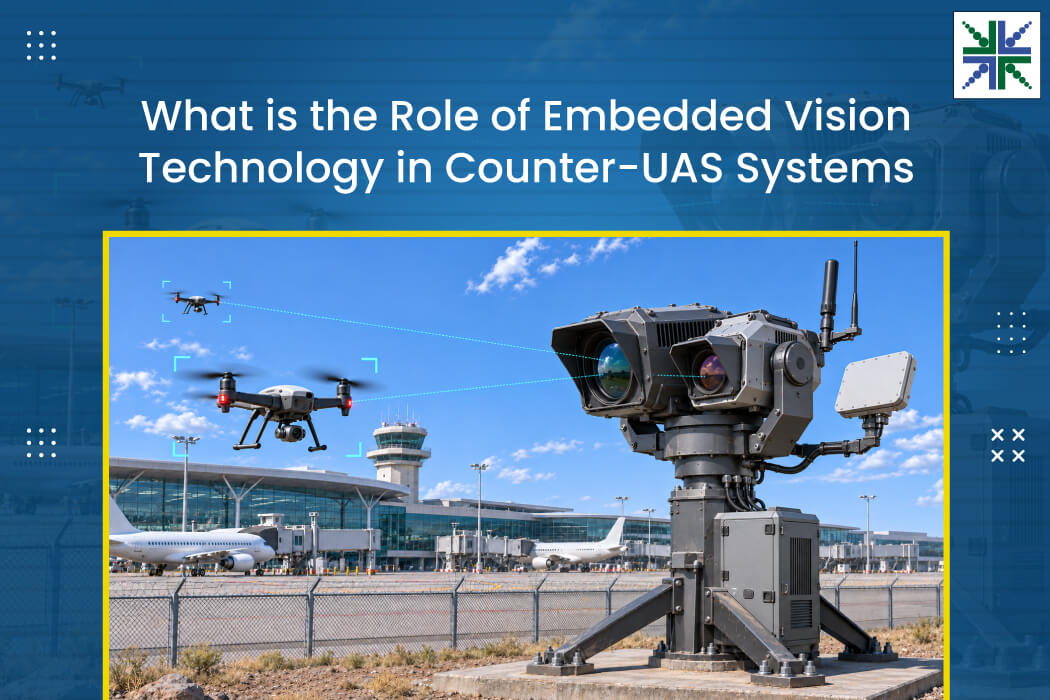
During the 2026 FIFA World Cup, authorities reportedly seized over 700 unauthorized drones in restricted airspace, highlighting the challenge of monitoring airspace around major public events. Airports and critical infrastructure facilities face similar concerns, where unauthorized drone activity can pose safety and operational risks. Detecting an aerial object is only the first step because teams also need enough information to identify, classify, and track it as it moves.
Counter-UAS systems address this challenge through a combination of sensing technologies, each contributing different types of target information. Radar can track aerial movement, RF detection can identify radio-frequency activity, and EO/IR cameras ultimately provide visual data.
In this blog, you’ll learn how Counter-UAS components work together, the role of embedded vision in drone identification, classification, and tracking, and how these technologies are used for public safety, airport, and critical infrastructure monitoring.
What Is a Counter-UAS System?
A Counter-Unmanned Aircraft System, or Counter-UAS system, is designed to detect, track, classify, and inform responses to unauthorized or potentially threatening unmanned aerial systems.
Rather than relying on one source of information, the system brings together inputs from multiple sensing technologies to build a clearer picture of the aerial target. These inputs help move the process from initial detection to target assessment and continued tracking as the object moves through the monitored area.
This coordinated approach gives operators the information needed to understand what has been detected and follow its movement in real time.
What Are the Key Components of a Counter-UAS System?
- Ground surveillance radar detects aerial activity within the monitored area and follows the position and movement of an object. This gives the system an early indication that something has entered the coverage zone and provides a basis for continued observation.
- RF detection contributes information from radio-frequency activity linked to the drone. Used with other sensors, RF data gives the system another observation that can help build confidence around the detected aerial object.
- EO/IR cameras provide the visual layer. Once the target enters the camera view, the system gains imagery that can be examined as the object moves. This image stream becomes the basis for visual identification, classification, and tracking.
- AI-based analytics processes the data produced by the sensing stack. It can use the available radar, RF, and camera inputs for classification and to maintain a usable track of the aerial target.
How Embedded Vision Works In Counter-UAS Systems
Embedded vision forms one part of a Counter-UAS sensing architecture that brings information from several sources together. The camera therefore has to operate within that wider system, with its image stream contributing alongside the other sensor inputs used during drone detection and tracking.
For developers, this means camera integration has to be considered in relation to the complete Counter-UAS system rather than as a separate imaging function. The camera output becomes part of the information available to the system as it follows the detected aerial object in real time.
Identifying the aerial target
An initial detection determines that an object is present. Identification requires information about the object itself.
EO/IR imagery gives the analytics layer visual data from the target in the scene. The system can use that imagery to determine that the observed object corresponds to a drone and combine the visual result with the radar and RF observations already available.
This gives the Counter-UAS system a stronger basis for target assessment. Radar contributes movement data, RF sensing contributes signal data, and embedded vision adds imagery that can be analyzed directly.
Classifying the detected object
Classification turns the visual observation into a usable target category. The analytics layer can examine the camera stream and use the image data to determine how the detected aerial object should be categorized.
Such classification gives the system a defined target to follow. It also connects the camera feed with the wider sensing architecture because the decision is informed by the visual stream together with the other available sensor inputs.
Tracking the drone as it moves
Tracking is a continuous task. As the drone moves through the monitored area, each new camera frame gives the system an updated visual observation of the target.
As the drone moves, the EO/IR camera provides a continuous visual feed that helps the system keep the target in view and update its position. Radar and RF data can complement this imagery, giving the Counter-UAS system multiple inputs to track the drone and assess its movement as the event unfolds.
Continuous tracking provides the Counter-UAS system with updated target information as the drone moves through the monitored area. A single detection captures the drone at one moment, while tracking follows changes in its position and movement.
So operators get a better view of where the drone is heading and how its path develops over the course of the event.
Popular Counter-UAS Monitoring Applications
Public safety monitoring
At stadiums and other large public gatherings, unauthorized drones can interrupt events or create safety risks for spectators and performers. Camera imagery helps security personnel examine aerial detections and follow a drone’s movement across the monitored event area alongside radar and RF observations.
Airport monitoring
Drone incursions around airports can disrupt air traffic and jeopardize passenger safety. EO/IR cameras provide visual information about detected objects, helping airport security teams assess drone activity and follow flight paths near monitored boundaries and operational areas.
Critical infrastructure monitoring
Refineries, nuclear plants, ports, and utilities face concerns ranging from unauthorized surveillance of operations to the observation of site perimeters and security arrangements. Embedded vision contributes visual evidence for assessing aerial objects and tracking their movement around these facilities.
How e-con Systems Helps Counter-UAS Systems Maximize Vision Performance
Since 2003, e-con Systems has been designing, developing, and manufacturing embedded vision solutions, from custom OEM cameras to complete ODM platforms. Our deep experience empowers those building vision into systems that depend on image-based detection, classification, and tracking.
e-con Systems can work with your product teams on camera selection, customization, and integration with the target compute platform based on unique imaging requirements.
Use e-con Systems’ Camera Selector to narrow down camera options based on your Counter-UAS imaging requirements.
Need help choosing the right camera or making it work with your existing hardware? Write to camerasolutions@e-consystems.com.
FAQs
- What is a Counter-UAS system?
A Counter-UAS system detects, tracks, classifies, and informs responses to unauthorized or potentially threatening unmanned aerial systems using technologies such as radar, RF detection, EO/IR cameras, and AI-based analytics.
- What are the main components of a Counter-UAS system?
The main components include ground surveillance radar, RF detection, EO/IR cameras, and AI-based analytics. Each contributes a different type of target information during detection, assessment, classification, and tracking.
- What role does embedded vision play in Counter-UAS systems?
Embedded vision provides image data that helps the system visually assess an aerial target. EO/IR camera feeds contribute to drone identification, classification, and continuous tracking as the target moves.
- Why are multiple sensing technologies used for drone detection?
Each sensing technology contributes different information. Radar tracks aerial movement, RF detection recognizes radio-frequency activity, and cameras provide visual data that analytics can use for target assessment.
- How does AI contribute to drone identification and tracking?
AI-powered analytics processes inputs from cameras and other sensors to help classify detected aerial objects and maintain a usable target track as their position changes.

Ram Prasad is a Camera Solution Architect with over 12 years of experience in embedded product development, technical architecture, and delivering vision-based solution. He has been instrumental in enabling 100+ customers across diverse industries to integrate the right imaging technologies into their products. His expertise spans a wide range of applications, including smart surveillance, precision agriculture, industrial automation, and mobility solutions. Ram’s deep understanding of embedded vision systems has helped companies accelerate innovation and build reliable, future-ready products.