



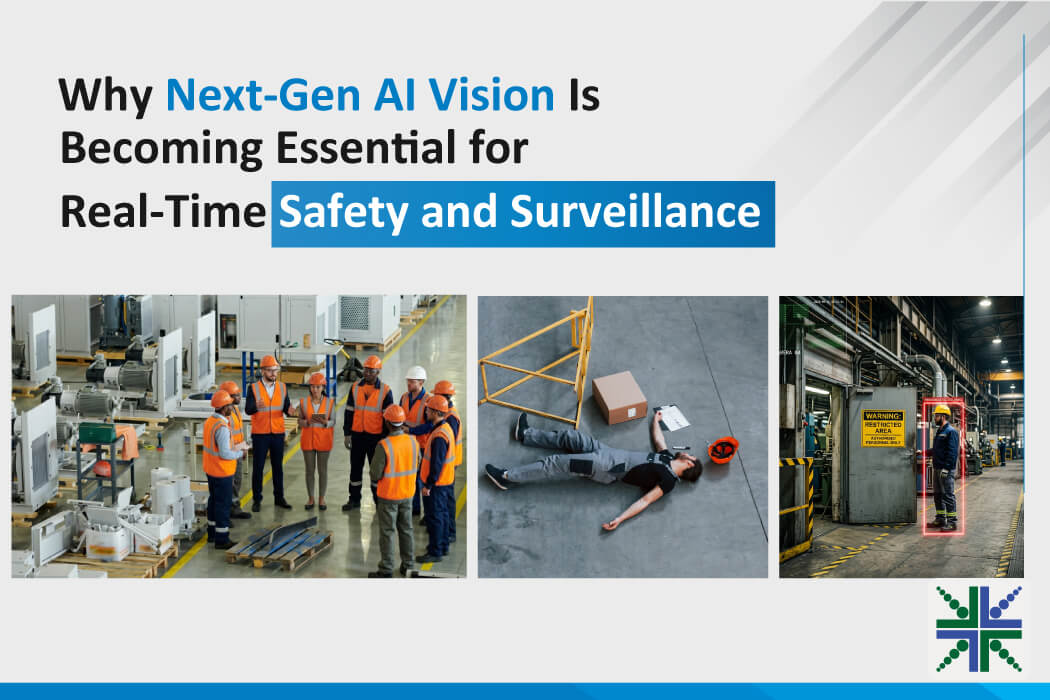
Surveillance has always been rooted in vision. But in today’s industrial floors, public infrastructure, and high-footfall environments, seeing alone is no longer enough. Modern safety demands require systems that capture what is happening, interpret it, and then respond before risk escalates into a real threat.
That is changing how surveillance system developers think about cameras. The transition from passive recording to active, real-time intelligence is no longer a future consideration. It is a requirement driven by tighter workplace safety regulations, faster operations, and environments that change in seconds.
The Limits of Traditional Surveillance in Demanding Environments
Conventional camera setups were designed for recording. They struggle where it matters most, namely in scenes with wide contrast ranges, fast-moving subjects, complex layouts, and round-the-clock operating hours. Glare washes out critical detail. Motion blur fragments records. Blind corners leave high-risk zones under-observed. And when every routine movement triggers an alert, operators face cognitive overload before any real hazard is flagged.
The underlying problem is architectural. Traditional surveillance depends on human attention to interpret what cameras capture. But attention has limits, especially during long monitoring shifts across multiple feeds.
Hazards that develop gradually, like PPE gaps during zone transitions, crowd compression in corridors, or subtle structural changes, fall through the gaps.
How AI Vision Changes the Equation
AI vision systems analyze visual input at the point of capture. Rather than relying on downstream review, these cameras interpret posture, movement, spatial proximity, and scene anomalies in real time. The result is a surveillance model built around understanding what is happening.
This delivers measurable impact. Detection of fire indicators, fallen workers, PPE lapses, unauthorized zone entry, and abnormal crowd density can all happen within the same moment the visual cue appears. Alerts reach the right people faster, intervention cycles shorten, and the gap between a developing hazard and a safety response narrows significantly.
On-device processing also reduces dependence on centralized infrastructure, lowering network load and enabling localized decisions, which is critical in environments where seconds separate a near-miss from a serious incident.
Some of the Camera Features Drive Reliable AI Surveillance
- High Dynamic Range (HDR) handling ensures detail is preserved across bright exits and shadowed machinery bays simultaneously.
- Global shutter capture eliminates the motion blur that makes fast-moving workers and vehicles difficult to analyze accurately.
- Low-light imaging sustains monitoring quality in nighttime operations, tunnels, and enclosed spaces.
- Rugged enclosures keep systems operational through vibration, dust, moisture, and temperature extremes.
These are just a few of the features that extend reliable coverage across the full range of industrial environments where safety outcomes are at stake.
Sounds Interesting? There’s a Lot More to Learn!
e-con Systems has published a new white paper called “Need For Advanced Surveillance Imaging: Next-Gen Vision for Industrial Safety”.
In this, we cover:
- The most common industrial safety risks that result from ineffective visual monitoring
- Why traditional surveillance setups fall short in dynamic, high-risk environments
- How AI vision enables real-time interpretation, early alerts, and proactive safety response
- Key camera features for reliable AI surveillance — HDR, global shutter, low-light, edge AI, rugged enclosures, and ONVIF compatibility
- Major use cases including PPE compliance, fire detection, fallen person monitoring, crowd density analysis, and zone intrusion alerts
- A real-world case study of a multi-purpose smart surveillance camera built for large public environments
Download our white paper to see how next-gen AI vision sets new surveillance standards for real-time industrial safety.

Ram Prasad is a Camera Solution Architect with over 12 years of experience in embedded product development, technical architecture, and delivering vision-based solution. He has been instrumental in enabling 100+ customers across diverse industries to integrate the right imaging technologies into their products. His expertise spans a wide range of applications, including smart surveillance, precision agriculture, industrial automation, and mobility solutions. Ram’s deep understanding of embedded vision systems has helped companies accelerate innovation and build reliable, future-ready products.